Sunday, April 08, 2007

We spend Easter planting the wildlife corridor

I found this little fella (does anyone recognise it?) in the rip line we used to plant the eucalypts and acacias and currajongs in a 50 metre wide, 1.5km long wooded corridor that we hope will give the birds and small native mammals protection as they pass from remnant vegetation to remnant vegetation. This little lizard is our own DeGroot (the New Guard officer who slashed the ribbon when Jack Lang was to open the Harbour Bridge).
We are planting 3000 trees of various sizes to provide an understory as well as tall trees. We have our reasons: 1. Biodiversity is a charcteristic of a high soil carbon environment. This corridor will encourage biodiversity above and below the ground. 2. Trees in buffers and scattered across grassland are also good for carbon.Scientific papers have said soil carbon is higher in the vicinity of trees. 3. Soil carbon increases soil producivity.
These rocks dug up by the ripper as it prepared the planting line shows you what we are farming on in some paddocks.
Dan's friends Simon and Bethany came to help, watering thousands of seedlings.
(More to come)

Tuesday, April 03, 2007

24 hours after a soaking in sugar water


This looks like one sick Bathurst Burr we've got in our experimental plot just outside the back door. This photo was taken exactly (give or take) 24 hours after a solution of 4kgs sugar and 10lt water was applied.

On the other hand, our lambs are to be drenched with Kelp and minerals, Cod liver oil, and Apple cider vinegar and garlic. Sounds like a recipe for something...

No culls this year?


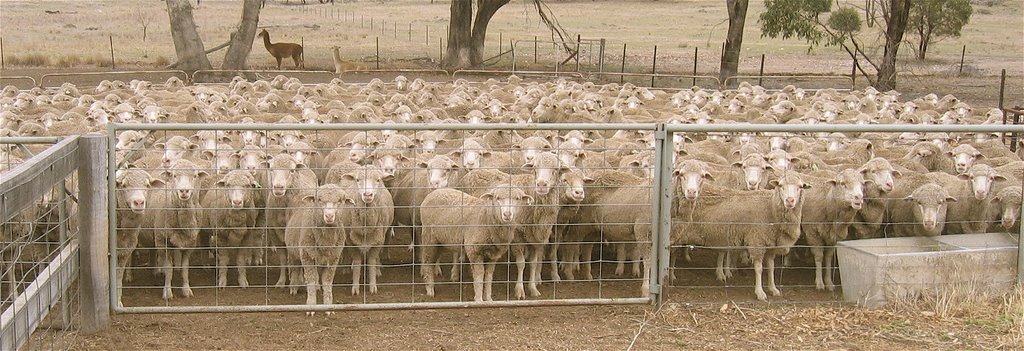
Normally we cull the worst 10% of our flock as a way of improving the genetics, ie. preventing the poorer animals breeding and adding to the gene pool. But this year we can't find even 100 sheep we can sell. Even the "Purple Taggers" (each generation of ewes has a coloured ear tag), who are 5+ years old, will be staying on. They have terrific wool and they are still physically sound (no broken mouths or distended udders, etc).

White sugar is poison to plants


We don't like spraying heavy duty chemicals on the soil or the vegetation because they kill the living things in on which we rely for productivity: microbes, insects, etc.


So we are always open to non-toxic alternatives. The chemicals for spraying on Bathurst burr (my greatest hate) are very toxic and dangerous for humans as well as bugs. So when we heard about sugar as a herbicide, we decided to attack the burr with it.


The amounts specified in the article we read are extreme: 1/2 kilo of sugar per square metre. Buying sugar at the supermarket could be prohibitive. We did it that way for our trial. Mixed up 4 kgs and sprayed a plot of burr 8 sq.m. in a spot that traditionally is our worst infestation. I also sprayed some individual plants in our back 'lawn' to have something I could watch daily. So far so good. The victims near the back door have started to get a droop which usually follows when chemical is applied.


The food nazis told us white sugar was poison back in the 1980s and campaigned against it like all good lifestyle nazis should. Little did we suspect that they were right on the money.

Pasture still thin on the ground

The green flush is all around, and it is so joyful to see the grasses return. Unfortunately it's a bit 'thin on the ground'. We need rain-and guess what!! The ants are back!!!! In their thousands - crawling all through the cupboards, testing every lid and package. They predicted the last rain, but they weren't very accurate about when.


Let's go and have a look at Middle Paddock. It looks good from the air and from outside the gate. But on closer inspection, it is a different story.


Windmill grass and couch grass indicate salination. There are patches of native perennials valiantly trying to re-establish.


But there are also many bare patches which will need more time to recover, and some special treatment. We had pasture cropped this paddock in 2004, which gave us an explosion of perennial grasses.


(Pasture cropping is the direct drilling on something like oats into a dormant pasture instead of ploughing and sowing conventionally.) Heaven knows what the paddock would look like had we not done that.


The sheep don't have a problem with the grass - they're just so happy to see it. They run from paddock to paddock when we are moving them. No need to push them. Just show them the gate.


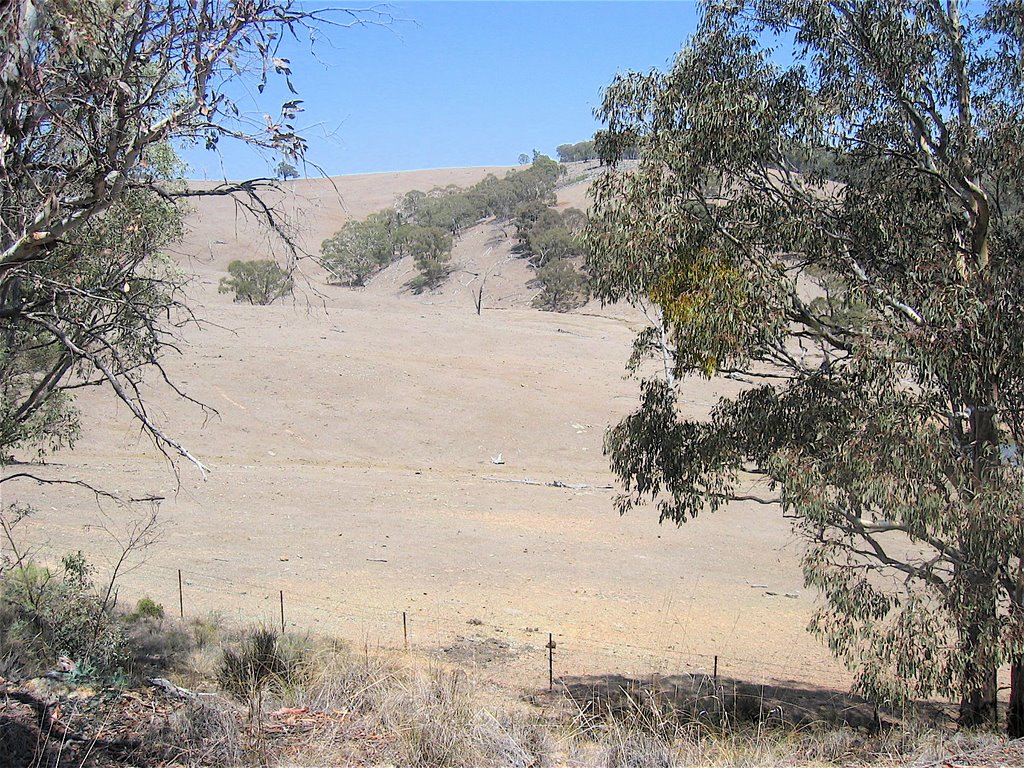
The impression that we are drowning in feed that the aerial photo might give is wrong. More than half the property is still in drought. Only those areas we were able to take the sheep off, thanks to our supporters. We fed the sheep in 'sacrifice paddocks' which you can see here.One of the sacrifice paddocks was called The Lease.


It is still struggling to come back. ALthough those sections where we spread Nitrohumus a few years ago (treated human biosolids) reveal better results.This treatment aimed to increase biological activity in the soil and kick start the restoration program.


We took advantage of the rest House Paddock was given over the last 3 months to allow some river red gums establish themselves in a paddock in need of trees. There has been one brave little gum tree growing well. So we protected four more seedlings to sede if they would flourish.


(I believe it is best the let Mother Nature decide what to plant and where. The tree is morem likely to survive that way. And we have planted many trees unsuccessfully over the years.) Here is our little master. He'll soon no longer need the protector.


And here is one of the babies - see how he grows in a few months.

Friday, March 23, 2007

Ah! Democracy... Election Day, NSW 2007


This is Erin Brockovich. She came all the way from America to help Patrice Newell attract media attention to the CLIMATE CHANGE COALITION - which is agroup of independents standing for the House of Lords... er, the Legislative Council, which is a direct descendent from the house of lords as it was originally made up of grandees and squatters and bunyip aristocrats - privilege and position and inbreeding don't make for a very good political system.

My contribution for the advertising was the following:

"FFFFFFFFFF" (CO2 ESCAPING)

VOTE 1 GROUP F TO STOP IT

You won't see it tomorrow or anytime.

Here is the official blurb:

CCC is not a political party. It is a group of 21 independents ensuring climate change is a primary consideration in all government business. CCC will work with any political group, community organization or individual taking positive action against climate change. Once elected CCC members will be free to vote on other issues according to their own conscience, but will take a combined stand on any issue impacting on climate change. The Coalition is united on all climate change policies and will assess all government proposals, including those for education, health etc for their impact on climate change. We will ask key questions about each piece of legislation that comes into the New South Wales Parliament. Does the proposed law address climate change? How can it be amended to make it better? See our policies at www.climatechangecoalition.com.au By scrutinising every piece of government legislation for impact on climate change, CCC will be able to lobby for changes to address the climate change problem. We will actively promote zero energy growth by 2010, ensure best practice standards are incorporated in all NSW standards for buildings and equipment, push for a moratorium on new coal-fired power stations and for a government commitment to a 25% renewal energy target by 2020. See our policies.

And this is my inspiration. When the future of the planet is in the hands of such an individual, everyone must answer the call. Mother Nature needs a hand.

Tuesday, March 20, 2007

Do you support the Carbon Coalition?

The work of the Carbon Coalition has been entirely voluntary for the past year. (SEE http://carboncoalitionoz.blogspot.com for out 12 month activity report.)

The Convenors have funded:

• lobbying,
• outreach,
• speaking engagements,
• website activity,
• blogging,
• research,
• overseas study tour,
• attending conferences to make contacts,
• appearing before official enquiries…

Please see the attached activity sheet. The time involved has grown to consume time previously devoted to income-producing activity. We can't go on this way. We need to professionalise the operation. Get serious or get out.

We believe the mission of the Coalition is too important to wind down at this important point.

We are on the point of creating the soil carbon market in Australia, We are enrolling landholders for trading.
But the challenges we have coming up include:

1. Being fobbed off with Federal Government Stewardship Payments instead of carbon credits. These are a poor substitute for three reasons: i. it puts you in the hands of the public servants; ii. They could never be as lucrative; iii. They represent handouts, not payments for produce. We believe the Howard Government is implacably opposed to soil carbon credits. (Leopards don’t change their spots.)
2. Missing out on offsets when on-farm emissions are measured/estimated and landholders are required to buy credits to offset CO2, methane, nitrous oxide etc.
3. Put an end to the myth about Australian soils and carbon.
4. Force the hand of the regulators (IPART) by forming markets.
5. Promote the notion of Carbon Farming among business as usual growers.
6. Maintain pressure for Australia to join Kyoto.
7. Protect landholders from exploitation by unsympathetic middlemen and opportunists.
8. Teaching landholders about the carbon trading markets.

We need your help…

We need your help to achieve the goals of the Coalition:

• Making the family farm more economically viable
• Strengthening rural communities
• Restoring the ecological health of farmland
• Reducing the extremes of Climate Change

What we need resources for…

• Website development
• Membership database system
• Publicity
• Management
• Lobbying
• Research
• Conferences
• Subscriptions
• Travel/Acc

There is so much more we can do… getting Members involved in our activities is FIRST AND FOREMOST… but it takes time and time is always short when you’re short of money.

WHAT CAN YOU DO?

There are many ways you can help:

• You can send a cheque to the Carbon Coalition Against Global Warming C/- MB & AL Kiely, “Uamby”, Uamby Road, GOOLMA NSW 2852

• You will find a “Donate” button on the website (www.carboncoalition.com.au) and on the blogsites.

• You can buy Australian Farm Soil Credits from http://carbonfarmers.blogspot.com

• You can engage CarbonCreditedBrands by visiting http://carboncreditedhowto.blogspot.com

Your contribution is an investment in the greatest opportunity to solve the problems of declining land health, declining economic health, and declining personal health in agriculture.

Thank you for being part of this historic moment.


Michael, Louisa & Daniel Kiely
Convenors

PS. Please pass this email letter on to others you may know who would be interested.

NB. YOUR TAX DEDUCTION: While we cannot offer tax deductibility as a CHARITY, we can arrange a deduction for you by the following means: 1. You make your contribution. 2. The Coalition invoices you for CARBON ADVISORY SERVICES (which is a legitimate part of our activities) and your receipt can be used for deduction.

Saturday, March 17, 2007

"Stands out like a beacon!"


When Holistic Resource Management International's Peter Holter and Judy Earl visited "Uamby" a month ago, Judy said it 'stood out like a beacon' because of the way we had conserved the vegetation and protected the soil. Now we know why she said it.

Daniel flew the light aircraft while the pilot took these photographs. This shows what our soil has done with the rain compared to the neighbours' (and compared to the 'sacrifice paddocks we used to hand feed our flock).

Amazing!

Look at the difference on the river banks - the erosion and damage on the bare side versus the vegetation on the green side. Stunning! Thank God for all our Adopting "parents" who enabled us to take the flock off most of the paddocks.

Obviously we were able to make full use of the rain. (Their animals keep breaking through our fences.)

Holistic Resource Management is the system of decision making we use to manage our farming enterprise. It was developed by Allan Savory and is practiced around the world by conservation-minded landholders because it gets results like these.

Friday, March 02, 2007

78MLS IN 30 MINUTES!

This is Daniel paddling in our sheep yards during a massive dump of water that almost washed us away! Luckily the lambs and the two new rams had been moved to the shearing shed the day before or we would have lost large numbers drowned in the flood. This was the rain we have been waiting for for 12 months. Now we will see the benefit of retaining grass groundcover in the way the grass will regrow. Also we have not lost the tonnes of topsoil that would have been washed into the river had we eaten out the pastures. Now we need a 10ml-20ml follow up fall in a week or so and in a few months the pasture will be reestablished. It's too early to put the stock onto the grass. (We have 3 weeks' hay and grain left in our reserves.) To all of you who have renewed your adoption for another 100 days, THANK YOU. Thank you, everyone. We are truly blessed.

Saturday, February 17, 2007

Speaking to Carbon Farmers in South Aussie


Last week Louisa and I travelled to Tanunda SA to speak at the South Australian No Till Farmers Association. No till farming is a conservation approach to cropping which avoids the damage ploughing can dol to soils tructure and soil carbon (it releases large amounts of CO2). South Australia has many no till farmers because they generally have very low rainfall and no till retains mositure in the soil. I can confidently predict that the future belongs to no till.

Thursday, February 15, 2007

A hard day with the conservation farmers

One year ago to the day we launched the Carbon Coalition at the Central West Conservation Farmers Association Conference. We've battled to get any attention from the media. Pictured interviewing me is ABC Rural Radio's Bruce Reynolds, who still thinks we're crooks. You can see it in his body language. Getting the indea of climate change across has been a very difficult task.

Lightning is good for Uamby


Did you know that lightning is good for growing plants? It creates nitrogen in the air which settles on the plants and helps them grow. The high energy in lightning mixes the oxygen and nitrogen in the air to form nitrates. These dissolve in rain and falls to the ground.. we've noticed the effect...

Garden gone...


This was our lush vegetable garden. Organic. Terrific. established with the guidance of Laurie Thomson who teaches organic gardening at the Canberra Institute of Important Things (or somesuch name). The important thing is that Laurie taught us out of the goodness of his heart.
This is our pile of sheep manure, 'mined' from under the shearing shead by various visitors and guests, notably my good friend and mentor Constant Berhends.

It's crutching time again....


Yes, folks, it's that time again. Crutching!! This is the time when our shearers Steve Minnett and Col Doherty trim the wool from the faces of our adult sheep (to keep them from going wool blind.) They also trim the wool from around their butts to stop "daggs" building up (accretions of excreta) dollops of dung, hanging off the back, making them uncomfortable (becuase, unlike you and me, sheep can't get around to wipe their behinds. (Heaven knows how they got on before man with shears arrived on earth.
Steve and Col are our shearers - "our" shearers - because they care about doing the best job. Perfectionists. And nice blokes, too. We use them as often as we can get them. They are part of the family. It's an amazing relationship when you really get to know the inner life of afellow human being. And shearers are fearless about expressing themselves and revealing their feelings (after 20 million beers).
They are very professional, work very hard, in conditions most city people would reject. They make it 'a good shed' - a shearing shead is a very tense place at times, with so many sheep being processed. A good sense of humour is essential.


The rhythm of the seasons beats loudly like a drum on Uamby. EAch month has its events and episodes.


Wednesday, January 31, 2007

'Seeing' the future


Diana, one of our 'adopting parents' and a medium, sent us the following email:

Hi Michael
When I was reading your newsletter, I got the 'idea' that you could expand or sell your concept to a cover more than just farmers and their stock - it could reach a wider audience - there is a niche group 'out there' for your (selling) concept. Without knowing you, your full concept (whether it is user friendly and can be adapted) I am relying on my mediumship to fill in the blanks.
Roughly I 'see' changes being made to your plan. Next I feel you will meet with an entrepreneurial type man from the X generation. Months pass before the plan becomes the final concept. Marketing will be easy. Finding the right person (male with NLP training) to travel miles demonstrating and selling your concept will be like finding a needle in the haystack but perseverance will pay off. I feel your original plan to save the sheep will then succeed for many years to come.
I feel you should take time out of your busy days to read over this email over and over until you 'see' the 'message'.
I wish you good luck if you take on this extra work (I am rarely wrong when I get 'ideas' concerning businesses) and remember to document the journey to fruition.
I should add that my adopting a sheep caused many of my friends and fellow exercisers to laugh - with words like 'trust you to find a way to help a animal at Christmas time'. Then they slowly realised that it was far better to do one little thing to help a farmer than just sit and watch the affects of the draught - feeling totally overwhelmed.
God bless
Diana

My reply outlines our plans to date:

Thank you Diana.

We have a business concept which we are 'conceiving'. It started with the desire to get a fair price for our wool, commensurate to the quality of the product we grow and the effort we put in. We intend to process and manufacture products for sale to consumers. The adoption scheme gave us the start of the process of identifying likely customers. (Unintentionally.) We will sell fleeces to spinners and craftswomen. We will spin the wool into yarn and sell it to knitters. And we will offer customers the opportunity to select and pattern or submit their won, and we will make up a garment, using a local knitter. I was blocked trying to think of how we could locate customers, but Adopt a Sheep opened the door. Our "Parents" might respond to the opportunity to purchase the fleece from their sheep, or the yarn, or a garment. On top of that we are exploring the opportunity of selling products with 'their sheep's' image on, such as t-shirts, coffee mugs, cushions, mouse pads, key rings, etc. These ideas are based on the belief that some (not all) of our "Parents" would like to deepen their relationship with their sheep and with Uamby. We also expect to have members of our new family come to stay and help with the sheep. Other products we could produce include postcards, childrens' books, photograph books, a book on The New Australian Farmer, a book on the ethics of agriculture (my field of study), a DVD on adapting to climate change. Further, we are deeply engaged in the climate change issue and will have 'soil carbon credits' for purchase soon, based on carbon sequestered in our soils and those of conservationist farmers from across Australia. We want to roll the whole concept out - already I have one young lady selling photos of their farm on Ebay to raise money for feed. I have helped her with publicity and website construction. Louisa and I are starting a series of seminars across the State to teach other farmers how to do it. We see this as part of our Mission to bridge the city-country gap. We then see opportunities for us as the retail shopfront provider for farmers who want to engage their 'new families' in the way we have outlined above - ie. we provide them with the infrastructure and management. We could also provide a farm stay booking service for farmers. All of this is driven by one thought: save the family farm, as an economic unit and as a sustainable environmental unit. Give farmers access to new revenue streams and incentives to conserve the environment by bringing city people and their needs and expectations into the equation. (Ie. an adoption scheme requires that the farmer be 'green' and ethical in their treatment of animals; growing soil carbon requires 'green' land management techniques.

We will read your message several times until we 'see' the opportunity. I welcome it. "ONWARDS!" is our motto.

Thank you for your guidance.

Michael

Monday, January 22, 2007

We stand for Parliament for our grandchildren's future


The Carbon Coalition has been invited to provide a candidate to stand as part of the Climate Change Coalition (CCC) in the next election for the NSW Legislative Council. Convenor Michael Kiely says he agreed to stand in the coalition of independents solely to give soil carbon credits a platform for greater awareness in the community and in government circles. For instance, in its press release headed "10 things the NSW Government can do now", number 10 is "Promote the sequestering of carbon in soil and foster a start up industry for the rural sector"

Soil carbon credits are the only viable solution to climate change in the short term.

The CCC is fielding a full ticket, headed by Patrice Newell, prominent Hunter Valley grazier and olive industry figure.

YOU CAN HELP:
Members of the Carbon Coalition can help us by registering to hand out 'how to vote' forms at their local polling booth for part of the day on 24th March, the election day.


The following is an introduction to the CCC:


We've formed the Climate Change Coalition to accelerate action by politicians from all parties on the most urgent and important issue in human history.

While the Coalition is not itself a political party it supports many Independent candidates who are committed to its platform.

Climate change is no abstract scientific or environmental issue. It impacts on every part of our daily lives. It is personal, local, national and global.

The time for denial is over. The political posturing and games must end. We must unite to ensure urgent action so that our children and grandchildren can have a sustainable future.

While we might be divided by ideology, religion, geography, history, class or self interest, we must come together to ensure the survival of our planet.

It is vital that the Climate Change Coalition’s values be represented in the New South Wales Parliament. All legislation needs to be assessed and scrutinized to evaluate its impact on climate change.

Members of Parliament who support the Climate Change Coalition are committed to asking two key questions about each piece of legislation that comes into the New South Wales Parliament. Does the proposed law address climate change? How can it be amended to make it better?

We recognise that there are MP's on all sides of NSW's politics intent on doing the right thing. They are often prevented from speaking out by party policy or pressure groups. We will work with them to get a freer debate - to produce the dynamics of the "conscience vote" across the legislative spectrum.

Further, the Climate Change Coalition will work with any group, organization, or individual to form alliances and encourage political creativity. There is no guide book to what must be done. There is no precendent for this crisis. It requires entirely new scientific, communal and political approaches.

Whatever our differences on other issues, whether we're left wing or right wing or middle of the road, is irrelevent. We must work together. Now.

Patrice Newell

Saturday, January 20, 2007

Flogging a dead horse called "Rainfall"

This is conventional drought management in Australia. This is what is called 'flogging the land'.

If there was an RSPCA for soils, this farmer would be prosecuted for cruelty. Cruelty to the biological communities that live in it. Cruelty to the poor plants that try to grow to feed his sheep. Cruelty to his sheep for depriving them of nutritious pasture. Crulety to his financial position. And cruelty to the public image of farming.When you hear the words 'sustainable' used in agriculture, know that what you see here is unsustainable because there is only one place this operation is headed: down the chute.

Many farmers hang on to their stock for as long as they can... until their soil is bare and even the roots of the plants have been consumed by starving stock... until their stock are so weakened they can barely walk onto the truck to go to market... where their presence under the public eye is an embarrassment to those concerned with the industry's image. Why do they do it? These words came out of the mouth of one of our neighbours last week: "You try to hold on to your stock as long as possible because if it rains that's when you can make some money."*

Farming is an extreme sport. You drag yourself back from the brink as each drought breaks. You consume your asset value until your ship comes in. In every decade there are several dry years, several ordinary years, and - if you're lucky - a couple of boom years. It depends on where you are and what you're in.

Australian farmers have come to accept that the way to survive in the driest continent with the most fragile soil structure is to overstock, to flog the land. "It comes back," is a common statement. But in 200 years we have lost 50% of our topsoil and in the past 30 years we have lost 50% of our soil carbon. This can't go on.

These are the bare hills on the Sofala Road to Bathurst. Flogged bare. The day before, during a heavy rainstorm, we saw whole hillsides of powdered topsoil slipping in sheets down towards the gullies where it will be carried away.

Farmers are the biggest gamblers in the world. They bet on the weather. In Australia. They 'bet the farm' on 'an Autumn break' to get a crop or to give them some fodder to go into the Winter non-growing season. They have heard about 'risk management' - some of them have been to government-funded 2-day seminars. Our neighbour said the government had offered them $3000 to learn about farming. "But what could they teach me?" our neighbour said, without a hint of irony.. Nothing to learn. Been doing it so long... the same way. Flogging out the land during the regular droughts.

I am in awe of the knowledge of many conventional farmers. They can tell when it's going to rain. They can turn a piece of wire into any impliment they need. They can work like navvies. And they listen to new information and take it or leave it. They husband the land, looking after it as best they can. They also husband their animals, looking after them. I can think of 5 or 6 farmers in our district who fit this description. Then there are the others. Greenpeace uses them as targets to damage the entire industry. Some industry politicians will openly support these people while privately they bemoan the damage they do.

I can feel a song coming on. (Orchestra rises in background...

It's what their fathers' taught them.
It's what their neighbours do.
They wont read what you send them.
They don't want nothin' new.
Not from wankers like you.

You grow more grass than they can
They blame in on the rain
F'you ran the stock that they ran
You're understocked, it's plain
N' you're new to the farmin' game


*Just a glimpse of country life: We were speaking to this neighbour because their cattle were coming onto our place and eating our pastures because they'd eaten out their owner's place and even eaten out the next door neighbour's place (it is currently not being used by its owners). Now they were coming across the river and eating our paddocks out. "Well, if they're coming across the river there's not much we can do," said our neighbour. Uamby has traditionally been used as a 'Common' by neighbours who can't understand why time controlled graziers like us go ballistic if we move our sheep into the next paddock in the cell only to find it full of cow shit and empty of feed. They get a look of 'whaddaya complaining about?' when we see them about it. This photo shows how 30 cattle cleared out a small paddock in less than a day before moving on to attack other paddocks. Here in the country, it's not cool to complain about the theft of your pasture in a drought. It reinforces the old saying: "Good fences do good neighbours make."

Wednesday, January 17, 2007

Aussie Soil Carbon Credits for sale!

Buy Soil Carbon Credits from Carbon•Farmers™

We have dived right in the deep end and are offering soil carbon credits to the consumer market (see http://buycarboncredits.blogspot.com), targetting baby boomer grandparents concerned about climate change and the way the world will be when they aren't there to look after their grandchildren.

Why did we do it?
To raise funds for the Carbon Coalition and enable our work to continue.
To raise awareness of the opportunity soils offer in the climate change crisis.
And to break the cycle of fiddling while Rome burns favoured by bureaucrats and scientists.

Politicians and scientists want to argue about the precise dimensions of the lifeboats on the Titanic - subjecting soil carbon to 4 years of trialling before giving it the go ahead, when Stern and others give us only 10 years to make a dent in the legacy load of CO2 in the atmosphere and soil is the only solution with the existing capacity to sequester legacy load in the time we have left. Forests will cost too much to plant on the scale required, take too long to plant, and too long to sequester. Every other solution is aimed at preventing new emissions, not dealing with legacy load. We have got to get cash flowing into the pockets of land managers who to encourage changes in soil management to sequester more carbon. If we managed to increase soil C by 1% in 10% of Australia's agricultural soils, we estimate we could sequester 10 years worth of our emissions. Can you sense the urgency? We are also - concurrently - seeking funding for trials of 'carbon farming techniques' and seeking to build bridges with scientists, trying to find one or two willing to operate in the real world and not this absurd Alice In Wonderland world where you can measure everything but you can't do anything. Given the extraordinary degree of estimation and averaging in calculating C sequestered in trees and C released by power stations, the death of a thousand core samples inflicted on soil carbon amounts - in context of climate change chaos - either to conspiracy to prevent farmers access to the carbon market, or criminal negligence on the part of those who would rather find reasons why it can't happen than look for ways of making it happen. We live by the words, "Lead, follow or get out of the way." We may fail, but it won't be for want of trying.

Friday, January 05, 2007

DAN'S DROUGHT DIARY

Weaning the lambs from the ewes. By this stage the mothers are sick of them, and most of them have lost their milk. So to give the lambs a better chance a getting a feed (instead of competing with the ewes) and to free the ewes to graze unhindered, we have weaned the lambs.


A half grown lamb butting your udder 60 times a day is no life for a ewe.


The rain immediately set loose the worms. So we had to drench the sheep. We lost only three in this worm attack, a record low - because they are fitter thanks to you.


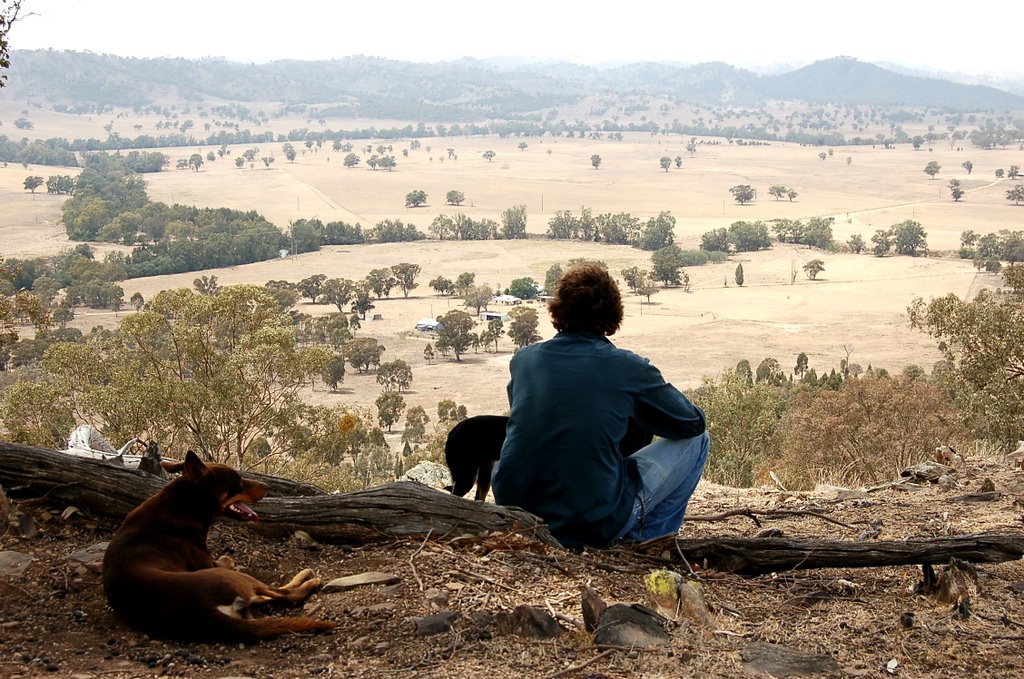
This is the view of the homestead from high on the hill behind the house.


Dan enjoys a short break.


We are restoring the pioneer cemetery down by the river.


No matter how dry it gets, the galahs always seem cheerful