Wednesday, April 12, 2006

Green Farmers Manifesto


A "Green Farmer" is an "agricultural entrepreneur who profits by following natural processes".
The "Green Farmer" is a better capitalist than the non-Green variety because tomorrow's profit is as important as today's. The Green Farmer builds the natural resource base he exploits to make money. The non-Green farmer depletes his resources, like soil and water.
The Green Farmer avoids costly inputs such as chemical fertilisers and heavy use of herbicides and insecticides, weaning his animals and plants off these expensive, but temporary, quick fixes.
The "Green Farmer" tries to get out of Nature's way, while the non-Green farmer confronts nature and struggles against it.
The non-Green farmer gives farming a bad name. It's the non-Green farmer and his industry spokesmen who the environmental lobbyists point to when they demonise farming as a profession and call for so many of its practices to be banned.
If the public knew the work of the thousands of Green Farmers across Australia - of the tree planting and the wildlife corridors and the soil conservation and species protection and the regenerative agriculture and lets forget about 'sustainability', it's meaningless. (Sustaining a sick system is sustaining sickness.) It is RECUPERATIVE farming that is going on here, there and everywhere.
The mainstream rural newspapers mention rotational grazing in every issue. "Sustainable" agriculture has been bandied
about 'til it has no meaning left... so it's a safe label for anyone. Imagine if all the associations and groups of farmers who take the natural path to riches - Green farmers all - formed a National Federation of Green Farmers. Imagine its members numbering in the thousands, to rival the NFF and associated bodies (who have a crisis of membership). Imagine the impact on public opinion when Green Farmers' Federation spokespersons are quoted taking a pro-nature stand on key issues.
We'd pull the rug out from under the "Green" lobby by stealing their name. We'd have them on toast because a lot of what they advocate runs counter to soil health and species survival - ie. locking land up and allowing trees to cover grassland species that cover the earth and prevent erosion. A commonsense voice in between the extremists. We would need to be broad church.
If we could recruit all those with experience in or practicing rotational grazing (HRM and GFP), organics, Natural Sequence Farming, Keyline Irrigation, Minimum-Till and No-Till Farming, Conservation Farming, Landcare members, Biological Farmers, Biodynamic operators, etc., what a force for good it could be.
It would be a loose federation of environmentally-conscious growers who are in the front ranks in the New Agricultural Revolution. No longer the weirdo next door or a secret society.
Leading agriculture out from under the crippling dominion of the pharmaceutical and petrochemical companies.

Friday, April 07, 2006

First Coalition Carbon scan underway

It's started! We have fired the first shot in our campaign to have soil carbon sequestration recognised as tradable carbon credits. We won't know for 3 years what degree of carbon sampling will be acceptable to the market, we are taking a conservative approach and measuring deep and measuring often. One metre deep and a core sample per acre.
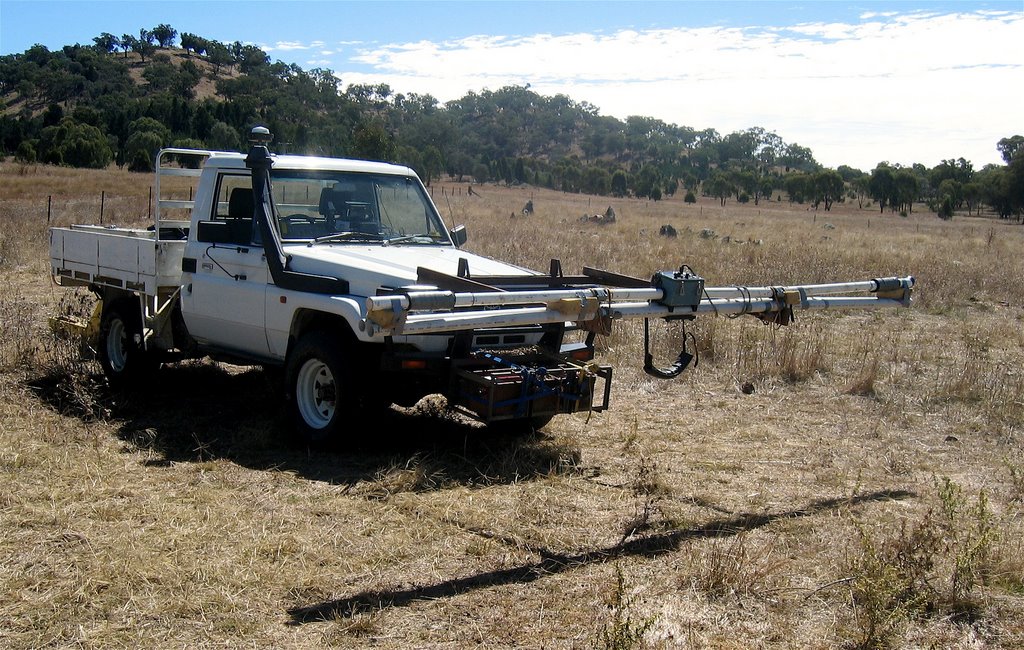
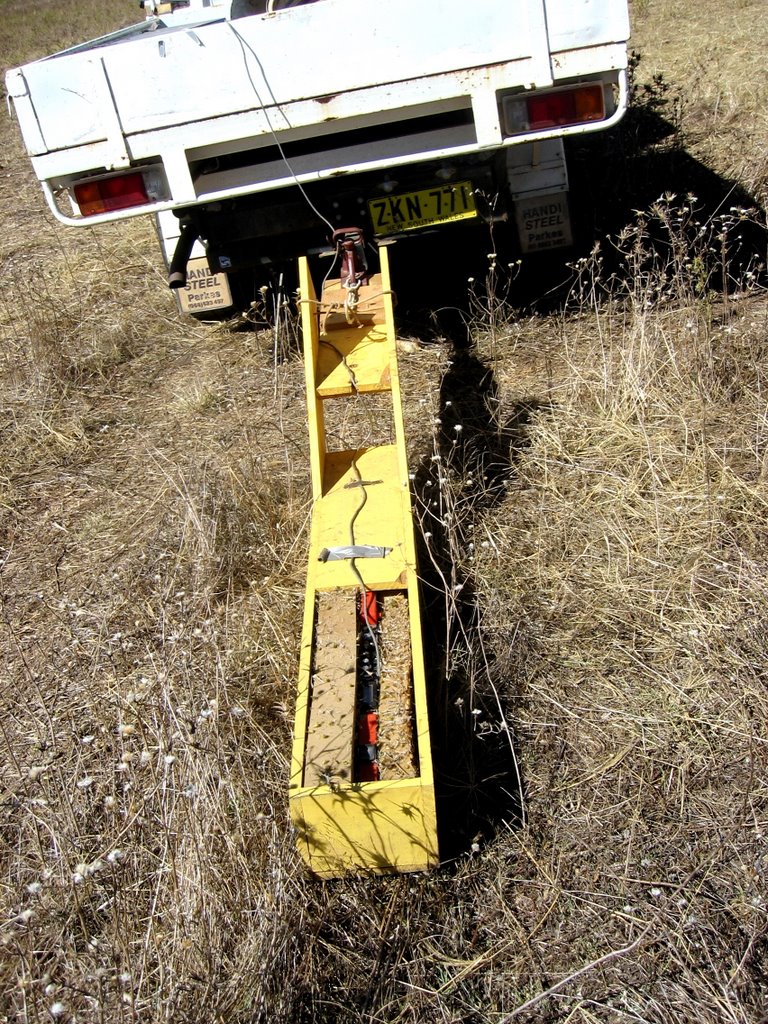
To map the carbon in the topsoil at Uamby, we have commissioned The Center for Precision Agriculture, an august body of soil scientists from Sydney University, to do a pretty standard mapping exercise, using both an EM31 and an EM38 device and a Gamma machine which measures the various radioactive signatures to a depth.

The EM is a standard soil mapping instrument that can give us a guide as to where we should drill for core samples. The Gamma is still experimental but we are told that it has achieved good results in estimating carbon. (I will blog these devices later once I've done my homework.)

Why sample 100cm deep when 30cm is advised?
The 1m of core sample that we have proposed is insurance. 1cm to 30cm was to be sampled in 10 increments to get the data that DR Christine Jones said would be useful i.e the three horizons to see the relative activities of each level. The 30 to 100 cm horizon was taken purely to complete the data set.

Our largest problem at the moment is finding someone to test the soil. It seems the cheapest we can find is $36 per sample, making it unrealistic for the 3 horizons to be tested. We are not giving up on this though as it is very worth while having the top 30 cm separately tested.

From our research, the approach to carbon "Measurement, Monitoring and Verification" adopted across the world varies from a mere estimation based on computer modelling aall the way to our over-cautious approach. We are adopting our approach because we have got to convince the marketplace of our bona fides.
We'll keep you informed.
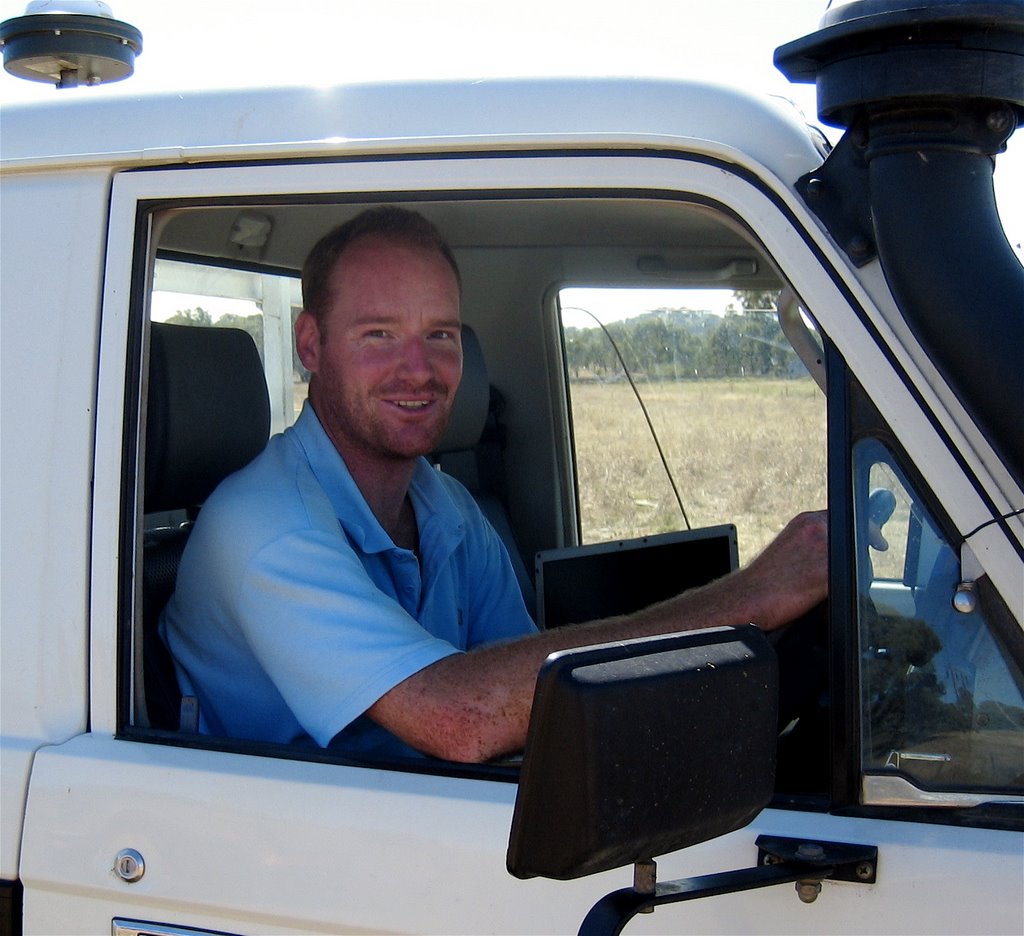
Driving the scanning rig is Michael Short from The Center for Precision Agriculture. Michael stayed with us for several days and had several adventures along the way. For instance, he drove across a rabbit warren which collapsed under him!

Dog today, dog tomorrow

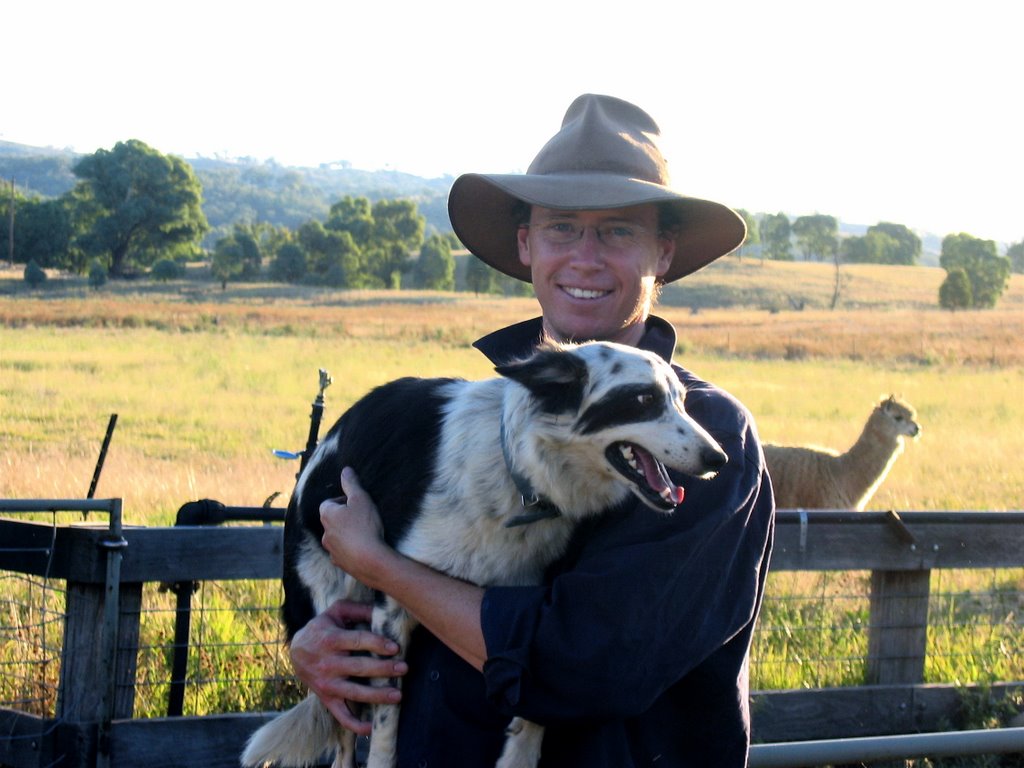
"Alas, Patch. I knew her, Horatio."Patch has left the building. Daniel offered her to Len Cooney, but Len said he couldn't take such a good dog. He took one of the pups instead - called him "Techno". Dan offered Patch to our shearer Col Dougherty, but he's got too many dogs as it is. We didn't offer her to Dan Gorrie next door. He shoots his dogs. We just give em away. But Col was going crutching out near Cobar - and crutched wet sheep for a day and a half. He had a mate out there who could give Patch a lot of sheep work. She's a good paddock dog, but hopeless in the yards.
Dan decided to keep two of the puppies (against all advice - you can't train two dogs at once, etc.). He called the sweet little bitch Lucy (on the left) and the male dog Jackson, after Michael Jackson, because he thinks he's cool (and he sleeps with chimpanzees. Kidding.) I wouldn't call my worst enemy a name after that freakshow.
Jackson and Lucy got straight into the flock at crutching a couple of weeks ago, and were almost trampled to death. But their genes say "Let's go round em up" and that's good. They are destructive little buggers, digging up the gardens and chewing up the shoes we leave at the door, or hiding them somewhere in the yard.

Want a puppie?

Wednesday, April 05, 2006

D-Day Minus 60


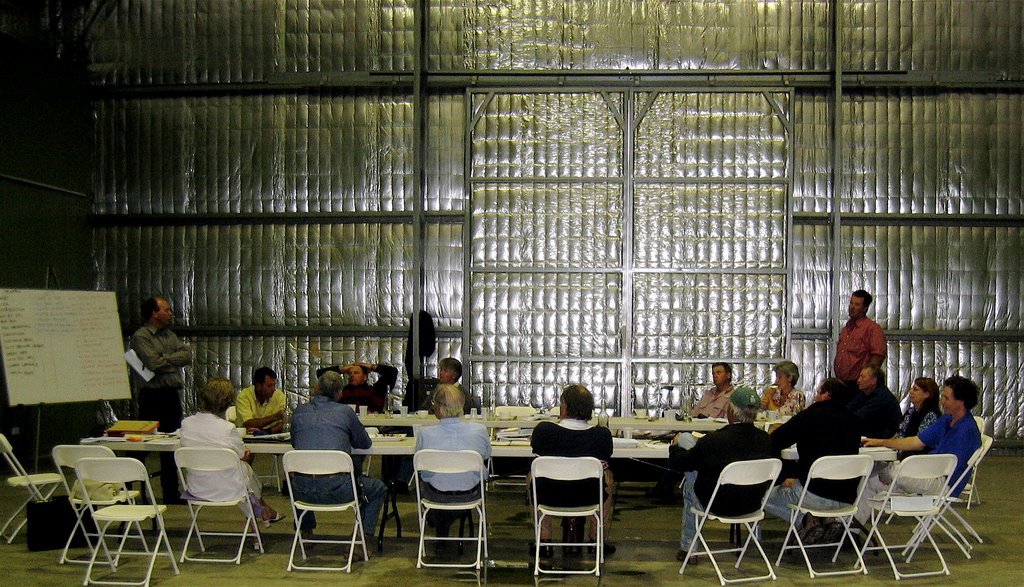
It's the agricultural version of the tv show "Survivor". Except 8 of the contestants will be voted off the island at the end of the show, which is now only 60 days away. This is our CMA Farming Systems class, 11 farm operations competing to come up with new ways to manage water to reduce salinity on the farm.
By now people are getting toey. No one knows for sure which way anyone will go, except for the Kielys of "Uamby" who posted their plan of attack on this blog, weeks ago.
(For those who missed earlier posts about this class, the Central West Catchment Management Authority - CWCMA - selected 11 farming families from 30+ applicants, for their opennesss to new ideas and their innovation on the farm. They are paying us $1000/day to attend classes on salination, water management, farm geology, soils, grazing and cropping issues, etc. And we are expected to produce, by 31 May, a whole-of-far plan which contains a new idea for managing water to reduce salt in the waterways of the State. This new idea has to be easily adapted by other farmers. Up to 3 of the entries will be funded up to $100,000 each to put the plan into action. All eyes are on the money!)
What hints do we have of innovative plans being developed? Not much. People have been playing their cards close to their chest. Some have been posturing and positioning themselves for a grab at the dollars. Some have complained that it's a race and said the $$$ should be shared out equally. I say "Let the games begin!"
We have opted to run our farm around the goal of lifting carbon levels in our soils, by whatever means a series of tests reveals is most effective for each soil type on our property. This entails mapping our farm for soil types, then core sampling it to measure the carbon as a baseline before testing treatments - such as rotational grazing, pasture cropping, application of nitrohumus (treated effluent), paramagnetic rock dust, biodynamics, complete rest, and whatever else comes to mind.
The mapping started today. (To prove we are serious we are spending $8,000 we haven't got to start the process. The core sampling will cost $44,000 because we are sampling 1000 acres at 1 sample per acre. Why so rigorous? To get our operation ready for Carbon Credits! Whatever the measuring/monitoring/verification methodology the market place goes wth, we want to be able to trade based on our increased carbon levels from the earliest date set for calculating amounts locked away.)
Some members of the class are tossing around ideas like edible shrubs that will aid biodiversity by providing an understory for bird life and also provide fodder for stock... At least 2 are thinking along these lines. Others are thinking about compost teas that you spray on fields. Again 2 are considering this. Bruce and Jenny are developing a wetland project on their horse property near Bathurst. Col Seis, the Father of Pasture Cropping, is expected to come up with an extension of this brilliant idea. Steve Kiss is toying with biodynamics. But the rest are sandbagging. Either they've got something hot, or they ain't got a lot.
I'll keep you posted.
Meanwhile we have the mapping to be completed this week, the fencing to start next week and the installation of the watering system (We are dividing the paddocks for rotational grazing - cell grazing using Holistic Resource Management principles)..>. More later.

Friday, March 31, 2006

Advanced sowing = minimum tillage = more carbon


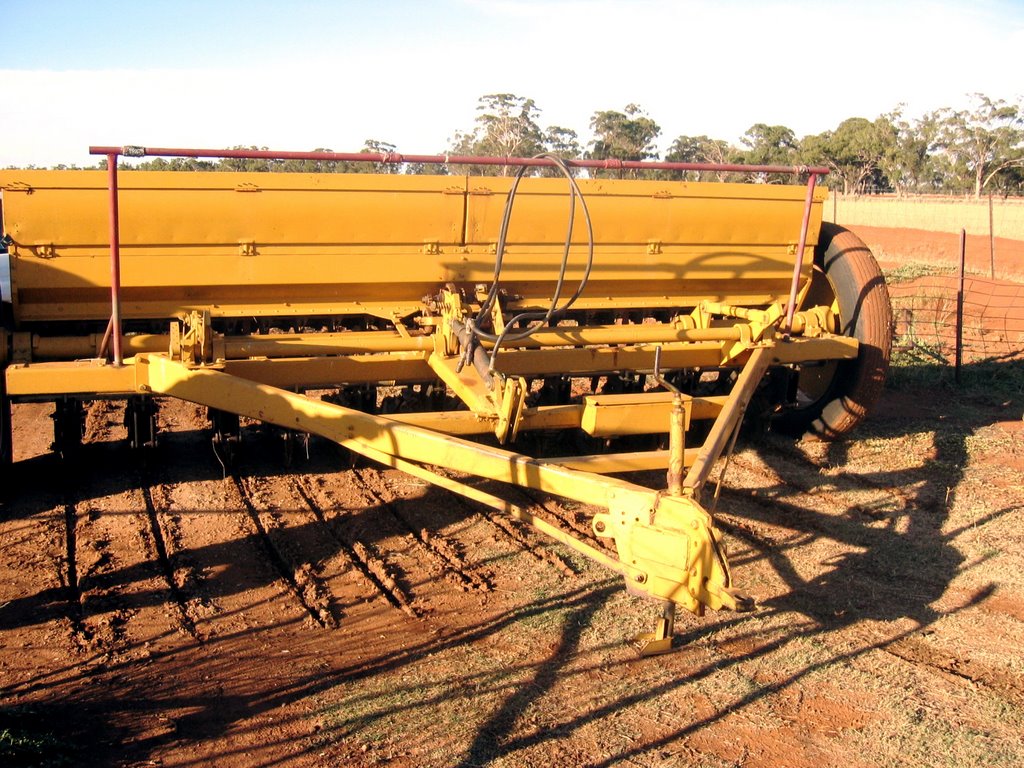
Louisa and I travelled to Narromine, about 150kms northwest of Goolma, to visiit Bruce Maynard at his property "Willydah". We were there to see Bruce's innovative farm in action and to talk about his stress free stock handling program (blogged last month). It is the neatest farm I have ever seen. Beautiful lines of saltbush, wide laneways, all the trailers parked in a neat line... I could blog on and on. One of Bruce's many contributions to carbon farming (soil management techniques that increase rootmass under plants to form a rich, living environment deep under the surface) is called "Advanced Sowing". Instead of ploughing the red soils and exposing them to wind and rain erosion, while betting on a rain even to germinate the seed each year, Bruce 'direct drills' seed into dry soil that is covered by pasture or 'trash' (stubble or leftovers from previous crops). The aim is to keep the soil covered and the rootmass alive under the soil.
The seed then germinates if and when it rains or when there is enough ground moisture. The weeds aren't given a head start by baring the earth (so there's no need to spray toxic chemicals) and Bruce continues to cell graze the plots to encourage the growing crop to compete with the weeds.
In 1995 he converted an old MF500 series combine by attaching "Acraplant units" to it. These discs cut a 1cm slot through the pasture without disturbing the soil or damaging the plants. A 1960s LandCruiser pulls the unit becuase there is so little resistance to the rolling discs. The Maynard family plants 100 hectares of oats and 400 hectares of forage sorgum annually, which can be stripped or grazed by the cattle. Lucerne and clover have also be sown into pastures using this method.
The financial risk is small, the working day is short, and costs are low. Total costs are calculated at $15.60/haa. If b eef is returning $1/kg, they need 15.6kg of beef/ha/year to cover the costs... Amazing.
Now they haven't had real rain out that way for 5 years, but we had a fall last night and Bruce had just finsihed sowing when we were there earlier in the week. Let's hope he got enough to get the crop to strike.
(By the way, soils with cover retain moisture better and lose less to evaporation.)

Wednesday, March 29, 2006

Is that Salt?

After 3 days' training on salination with the Central West Catchment Management Authority, I am seeing salt everywhere on Uamby. The Goolma district was a mass of red spots on the CMA map of salt outbreaks, so we know the district is on the high side. Over the last 2 weeks we have visited several properties further west and southwest, that have salt problems. The scary thing is that I think we have similar symptoms. Scary because salt can take a long time to rectify. And scary because no farmer wants to admit to salt.
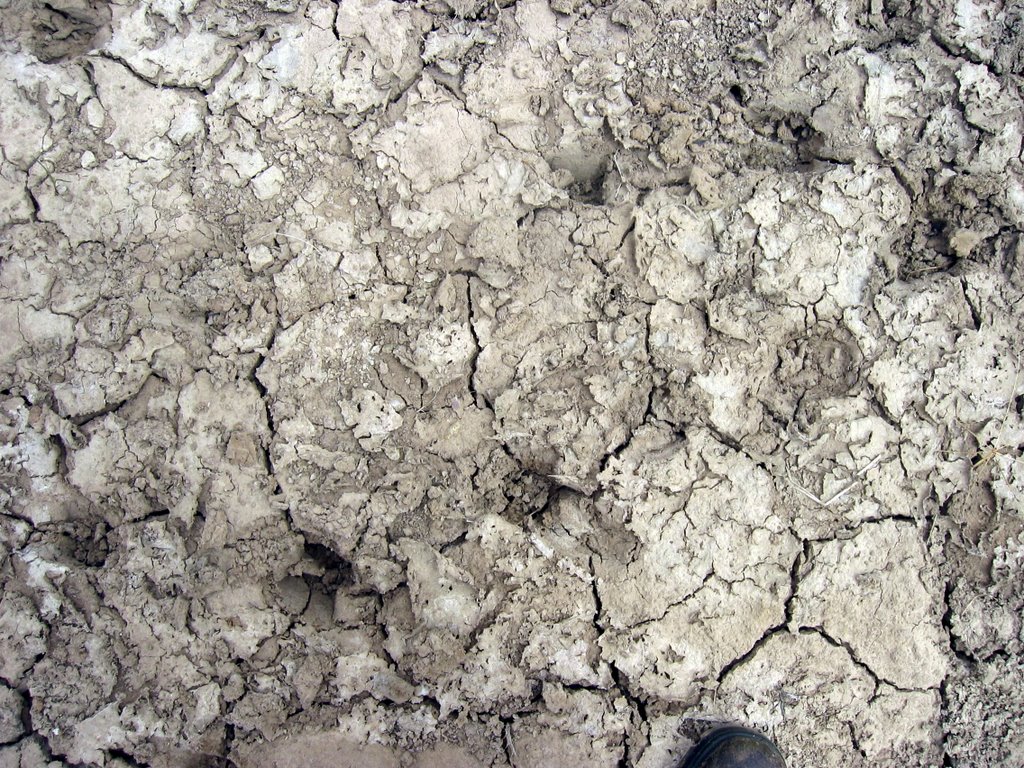
Here we are at one of the properties we visited: Bruce, Sam, Colleen, and Tim looking at the pale soil which is where the salt is 'expressing'. The salt-affected area on this property is growing because the farmer is not treating the cause, only the symptom. He's band-aiding the expression zone while continuing to farm around it in the way that caused it in the first place.


I took this shot on the property with the expanding salt area. This, plus the appearance of sea barley and couch grass (salt resistent plants), is an indication of sale.


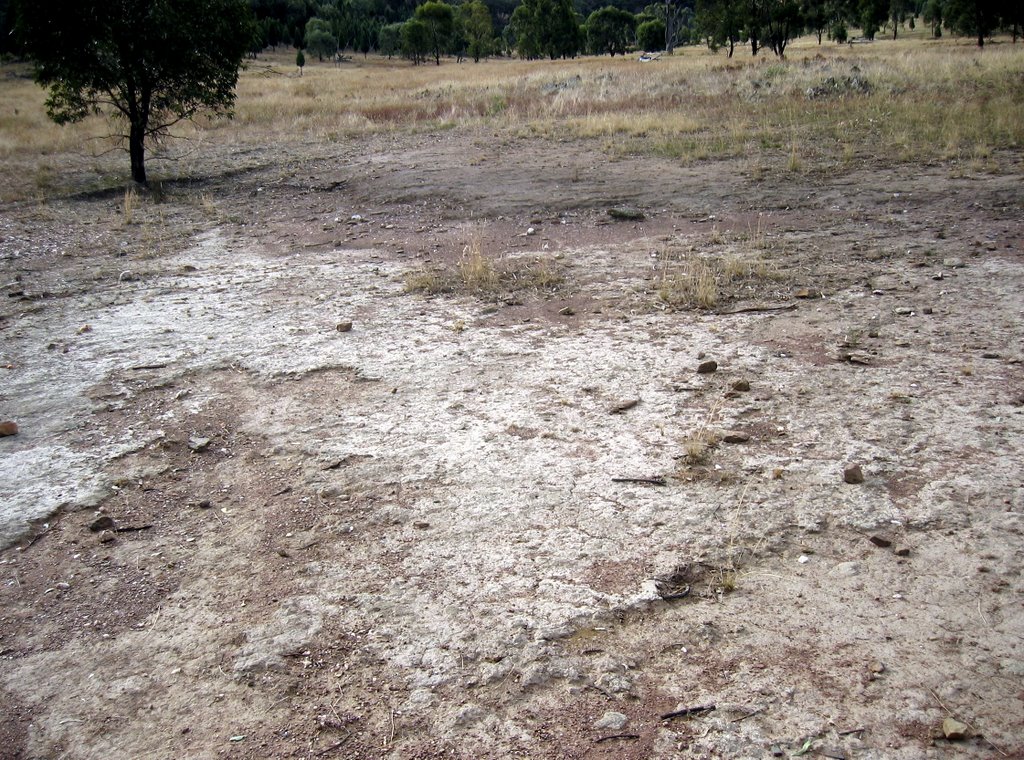
This shot was taken on Uamby, in the area we call the Lease. The top soil has been scraped away,we thought, by bulldozer activity. But it could be a salt scald. The similarity between this shot and the shots I took on the other property is startling.


And this is another patch, this time in the Hill paddock, just above the stockyards. This area becomes a river when it rains heavily, with water rushing down from the hills and coursing down the driveway past the house.


One piece of evidence that argues against it being a salt outbreak is the health of the trees and the grasses growing near it. If this is a salt scald, we know what we have to do to fix it. Grow more deep-rooted, native perennial grasses in the Hill paddock.

Tuesday, March 28, 2006

Harvest festival at Goolma

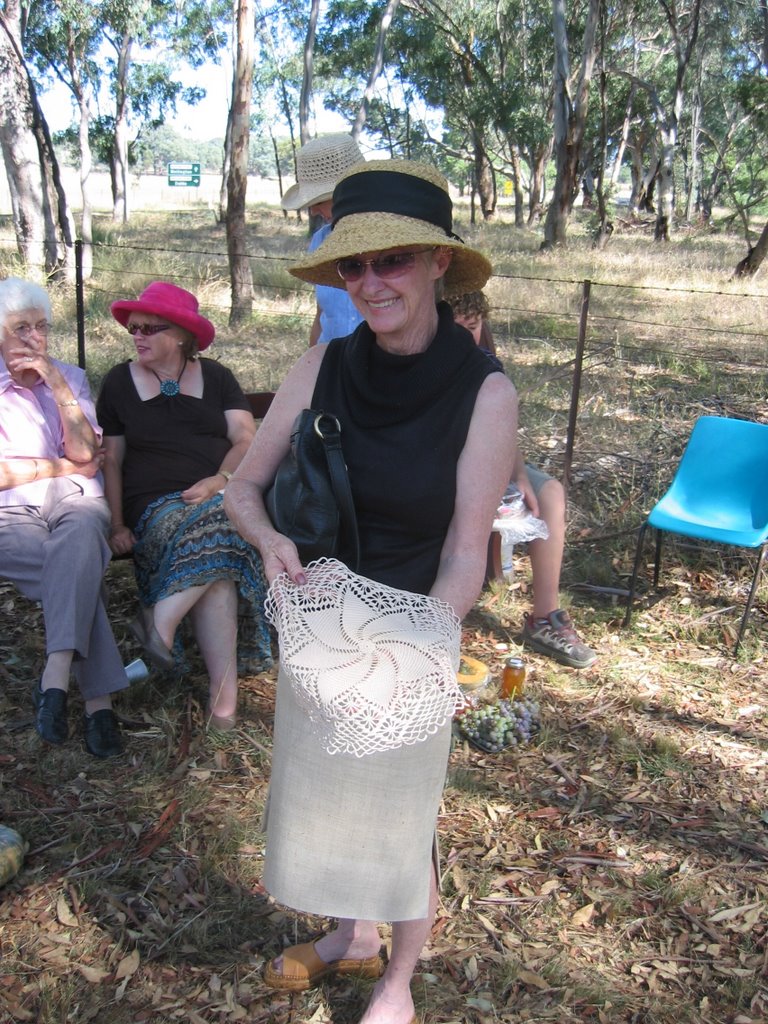
Last Sunday, a little bit worse for wear after Saturday's wine tasting expedition, Louisa and I attended Mass at ST Francis Xavier's church in the village then went up to St Mark's Anglican church for their Harvest Festival. People bring boxes of vegetables and garden-ready plants, as well as cakes and other produce for auction to raise money for amenities for the church.When we first arrived to live here we found that church is important because it is the only place you can guarantee meeting the community regularly. The congregat-ion (average 15 per Sunday at the Catholic Church) spends about an hour and a half chatting after Mass, usually about farming or gossip. It's like a community meeting. The Harvest Festival is the one time each year the two churches get together.Fleur Gorrie, our neighbour, writes down who owes what as the auctioneer works his way through the goodies on offer. We bid successfully on three large cakes, a tray of scones, a tray of cup cakes, two jars of grape jam, and 5 doilies crochetted by Shirley Whale.
The doilies are old-fashioned lace and beautifully made by Shirley who was cruelly treated by her ex-husband and abandoned. He is such a bastard... My Mum would say "There's a special place in Hell for him." And there is.
I asked Shirley would she pose with one of her doilies, and she did. I am always snapping away, the locals have gotten used to this madman from the city who arrived four years ago and will never be a local because he wasn't born here. We spent $91 at the auction and they raised more than $500, which is far more than they were able to raise in the town of Gulgong (population 2000).At the end of the auction it is traditional for a carton of chilled beers to be auctioned, then opened and shared around. One of the menfolk will pay $50 to bring it along while another of the menfolk will bid up to $60 for it. Then everyone has a beer. Pictured is Kevin Benson, local resident and the man who can remember everyone and everything. Prodigious memory. If anyone wants to know anything about anyone, they ask Kevin.

Sunday, March 26, 2006

Diary of a Carbon Farmer

I started this blog to chart my journey - both inside myself and in the world around me - towards discovering the meaning of this ancient Hasidic saying:

"When you walk across the fields
with your mind pure and holy,
then from all the stones,
and all growing things,
and all animals,
the sparks of their soul come out
and cling to you,
and then they are purified
and become a holy fire in you."

Along the way we have encountered many like-minded farmers and thinkers, people dedicated to proving that farming can be profitable while, at the same time, conserving and regenrating the natural environment. Next to Allan Savory, who gave us Holistic Resource Management, time-controlled grazing, and 100% ground cover, we have been blessed by discovering Dr Christine Jones and the mysterious stuff called CARBON. Regular readers of this blog will have seen the change towards Carbon since September last year when we first met Christine in Armidale. (We also met David Marsh, Rick Maurice and Colin Seis, carbon farmers.)

Christine has revealed that Carbon in the soil takes many forms, all of which play an active role in building and replenishing soil, aerating and strengthening soil structure, feeding and housing microbe, fungi and insect populations, holding and giving plants access to water, preventing erosion and silting of waterways, and fighting against salination by governing water dynamics in the environment. Carbon is the platform on which the food chain rests.

Whatever we do to encourage Carbon to grow in our soils, we are paying our huge debt to Nature for its forebearance.

Agricultural psychic Rudolf Steiner has something interesting to say about Carbon which I don't completely understand:

"Carbon is the carrier of all of nature's formative processes. No matter what is being formed, be it the relatively short-lived form of a plant or the constantly changing figure of an animal, carbon is at work as the great sculptor."

"The human spirit - what we know as the 'I' - moves through our blood along paths... laid down by the weaving and working, shaping and dissolving activity of carbon. And just as the human ego, the true human spirit, lives in carbon, so too does the universal ego in the spirit of the universe live...in the ever forming and dissolving carbon."

"All living things have an underlying carbon framework... and as the spirit moves through the world, it moves along the lines of this framework."

"Whenever we consider a human being or any other living being, we must realise that this living being is permeated by something etheric which is the actual bearer of life... The carbon framework of a living being has to be permeated by this etheric principle..."

I can't say it's right, but I'm not prepared to dismiss it, either. But even if we stick to what science can demonstrate, Carbon is amazing stuff.

That's why we have changed the name of this blog to 'Diary of a Carbon Farmer'.

Saturday, March 25, 2006

We drop in on Jane's vineyard

Jane Wilson is a jolly, animated and often stressed Scot who makes good wine - fantastic wine, in fact. After dropping by Botobolar (see last post) last Saturday during our official day off (we rarely get one), we thought "Let's surprise Jane!" She is one of the progressive farmers in our Catchment Management Authority Farm Systems class. (See earlier posts.) Jane and her husband David Lowe were gracious and hospitable, even though we caught them in the middle of a busy time making wine.

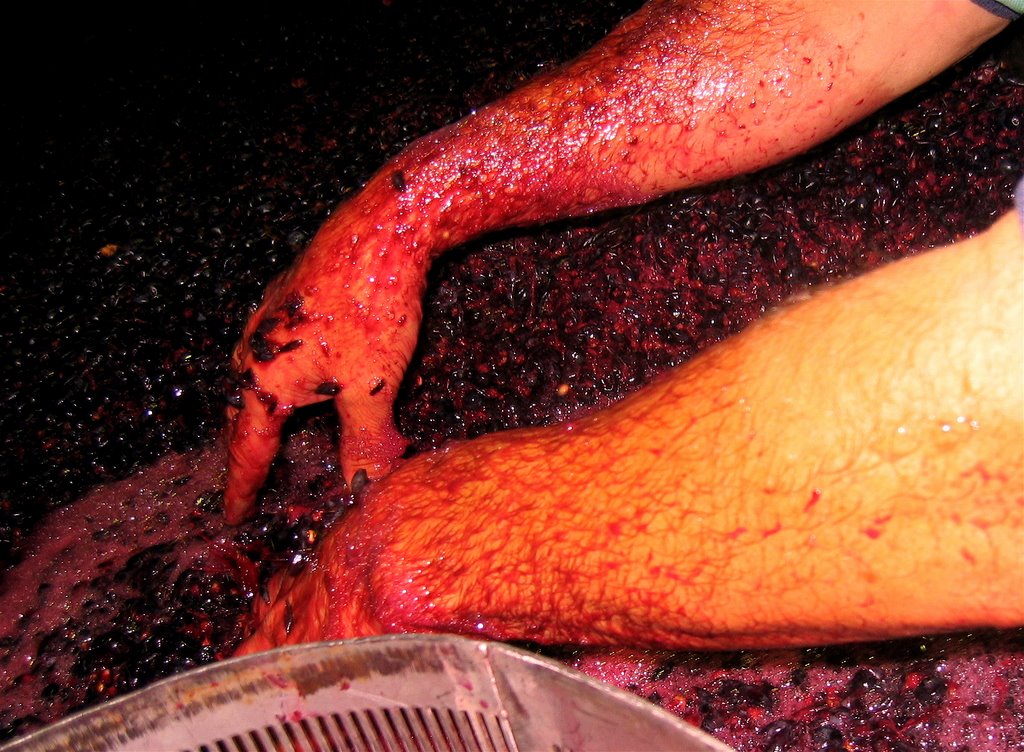
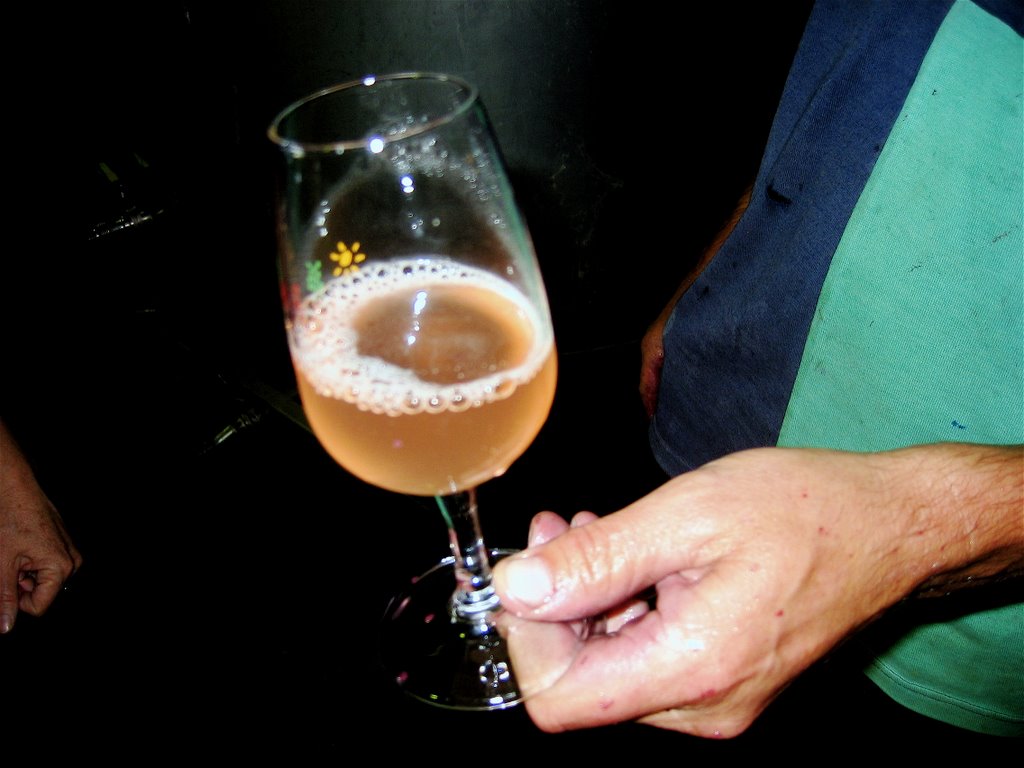
David gave us a grand tour, plunging his hands into the mushy wine mush to show us how it was made and pouring us a glass of raw wine (several glasses - a red and two whites) that were at different stages of development. The red was spectacular for an untouched wine. David said the less he has to do to a wine the better.

The whites were still developing. This pinot gris had a sweet apple juice flavour. We sampled their wines in their comfortable tasting area in the warehouse/winery (they live upstairs while their home nearby is being constructed - funky.)
Jane and David are big on soil. Soil creates the spirit of a wine. Perhaps 'soul' is better than spirit. They have developed a composting system, turning old stems, etc., into soil food. Jane is planning to use compost tea. (Yuk!)
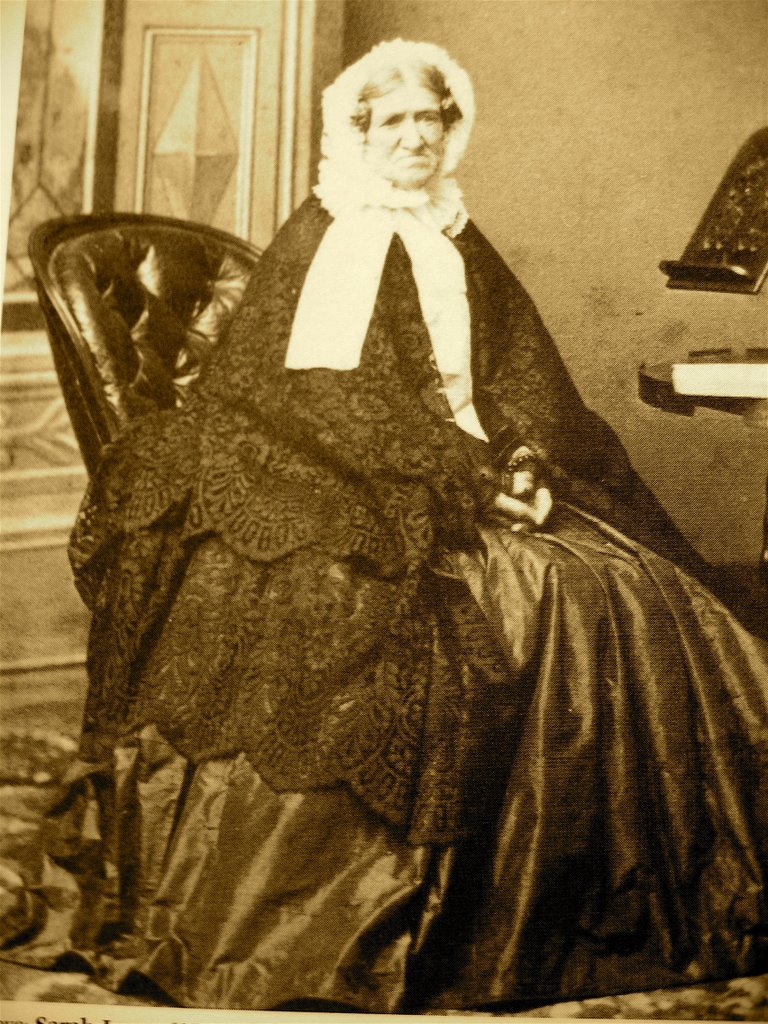
Lowe Family Wines are quality. In 1833, David's ancestor Sarah Lowe travelled with her large brood of kids, animals and wagons over the Blue Mountains to take up a large tract of land granted by the governor to her husband (who subsequently died). She ended up owning most of the land around us in this district - 12,000 acres - but the generations lost it through wine, women and gambling, says David. Now there's only the wine, and when it's that good you don't need to gamble. Visit www.lowewine.com.au and try the 2003 Mudgee Reserve Shiraz. We also loved the 2004 Mudgee Zinfandel. Both robust Mudgee reds. I'm going to have one right now!

We take a day off and go wine tasting


This is Kevin Karstrom. He used to be a merchant banker with Merryl Lynch, but he bailed a long time ago and bought an organic vineyard called Botobolar on the outkirts of the wine region around Mudgee. Mudgee is our nearest big town. Kevin is an American and he tried his hand at sheep when he left the big smoke, but sheep nearly sent him broke, so he stuck to wine making. The vineyard was estsablished in the 1960s or early 1970s by a journalist from Sydney who had had enough. He discovered that bugs were eating his grapevines when he tried to do without toxic sprays. Somehow he stumbled on the idea of leaving the weeds and grasses under the vines, giving the bugs something else to eat. After all, by taking away the weeds he was taking away their food, so they ate his vines.
Kevin is a cheery fellow and his shirt is cheery too on this Saturday afternoon when Louisa and I visit him. One of his sons was helping him with the wine vats and forgot to turn off a tap or something.
Anyhow we always by 3 dozen bottles when we visit, which is twice or three times a year. Kevin does a great Shiraz called The King after Elvis Presley. It is meaty, beaty, big and bouncy! Mudgee is famous for its big reds.
WHy don't you visit Kevin on www.botobolar.com and have a look around. You might even buy some wine. He'll ship it to you.
Cheers!

Monday, March 20, 2006

SShheeep Power In Action!

This is what 2000 sheep can do to 10 acres in 24 hours. This is called animal impact. We let this lot dry off – the first shot taken in December.
Then we let them in mid March to eat what they can find and stomp the rest in to the ground, along with their poop and piddle. It is a natural tilling and fertilising effect.
Long periods of rest followed by high intensity grazing and disturbance is the white man’s way of encourag-ing the perennial pastures.
The Aboriginal inhabitants used fire because they had no herding animals.
They were very astute with fire, burning in cools seasons, burning and beating the fire out with their bare feet to restrain its spread. They also used fire as a weapon of attack against inturders.

Friday, March 17, 2006

The future of agriculture is in their hands?

These are the smartest farmers in the Central West of NSW, searching for salt. This is our CMA Farming Systems class on a day trip to various sites around Wellington where salt is a problem. We learned the difference between salt load, salt concentration and salinity.
We learned that our area (Goolma distirct) is a salt problem area, so we'd better watch out for the telltale signs. Such as sea barley (pictured), a species that colonises saline land. I wonder when Christ said "Ye are the salt of the earth" if he knew that one day it wouldn't be such a good thing to be... More about salt later.

Wednesday, March 15, 2006

We've forgotten what we knew 2406 years ago

"To be a successful farmer one must first know the nature of the soil." - Xenophon, Oeconomicus, 400 B.C.

Friday, March 10, 2006

Abe, my carbon farming penpal

Abe from Vermont is another carbon farmer. Here is his comment to our post on calculating soil carbon:

.......

Again, I am with you folks. It seems I am commenter # 1. Hopefully the tide begins picking up soon.
We will be establishing baseline carbon measurements, measuring for all fractions on the farm this year. We'll see what happens after another year of Holistic Management Planned Grazing and Keyline subsoiling/irrigation.
Do you know of Keyline farms that are thinking/working along the same lines as you?
Please feel free to consider me a carbon farming penpal.
My lines of thought are exactly parallel to yours. I have presented at three conferences this winter on this theme, as well as hosted five workshops on the farm on same. People are listening.
Now, we are aiming to gather a group of graziers who also want to subsoil and monitor soil carbon to see what we can do in a year or two.
Best,
Abe

Thursday, March 09, 2006

Carbon farming at "Uamby"


MEMO TO THE TEAM

I think we are getting closer to a solution, after hearing Bruce's clarifications on Tuesday.

His document says: "Staged B Funding... up to $100,000... What outcomes are we paying you for? Stage B outcomes WILL INCLUDE on ground activities that: Reduce detrimental water flows in saline landscapes by the use of innovative farming (cropping and grazing) techniques that achieve triple bottom line results (ecological, social and economic)."

Key words: "on ground activities", "reduce detrimental water flows", "innovative farming (cropping and grazing) techniques", "triple bottom line results".

Our entry could be titled: Carbon Farming at Uamby. The strategy is to reposition us from being farmers who do a bunch of things to regenerate the ecosystem while farming to a farm operation totally focussed on growing carbon in the soil. That is our single-minded key point of focus and our single KPI. Everything flows into that concept and everything flows out of it. Simple.

We select our activities according to the 80:20 principle. Which 20% of our activities will give us 80% of our soil carbon solution?


We start building our whole of farm plan by mapping the property for soil types and topography. Then we take baseline carbon samples and have them analysed to establish our benchmarking process for both success of our farm management and possible carbon credits in future.

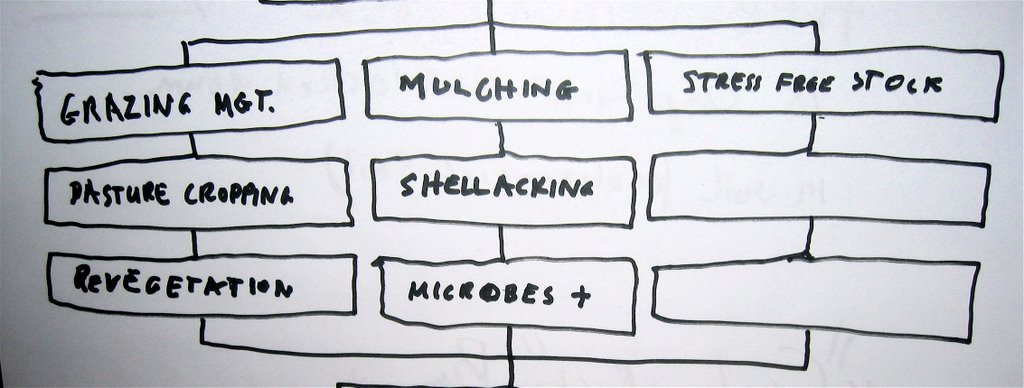
Soil sectors are targeted for different treatments, according to the soil carbon analysis result. Grazing management will be the primary tool used, supplemented by pasture cropping, to encourage deep-rooted perennial pasture growth. Mulching (using our mulcher attachment on the tractor) has proved very productive in turning long rank grass and thistle into fresh perennial growth. Shellacking (towing a weighted iron frame across tall standing thistle and foliage) is also useful in getting
dead matter into the ground before it oxidises. Kick start microbes may be needed in places. Stock handling practices can impact on ground cover, especially if sheep are walked rather than rushed and several attempts to get them through a gate are not needed. Revegetaion in wildlife corridors encourages diversity at all levels of the food chain.


Other techniques will be applied as they come available. Eg. the fungi that produces Gromalin, the insoluble organic carbon which is very stable and accounts for 7% of the world's soil organic carbon.

The demonstrated results will flow on to the triple bottom line thus:

Higher production - the stock carrying capacity (DSE) would increase signficantly. We are aiming at 100% increase.

Carbon credits - the carbon sequestered in the soils between our first baseline measurement and subsequent scores may be elgible for carbon credits which can be traded in the greenhouse emissions market. The concept of the carbon farm and soil carbon sequestration would be promoted by Uamby's activities.

Learning centre - it is envisaged that Uamby become a District Learning Centre where growers and the general community can come to learn about carbon farming. Meeting facilities and accommodation will be used to provide seminars and value-added farm stay experiences. The local indigenous community have shown an interest in conducting indigenous land use workshops on Uamby.

Environmental improvements - direct impacts of carbon farming include better usage of water where it falls, less erosion and runoff, less turbidity and silting in surrounding waterways, less salination, and greater diversity of microfauna and microflora, leading to greater diversity upthe food chain.

Monday, March 06, 2006

Here's our plan so far


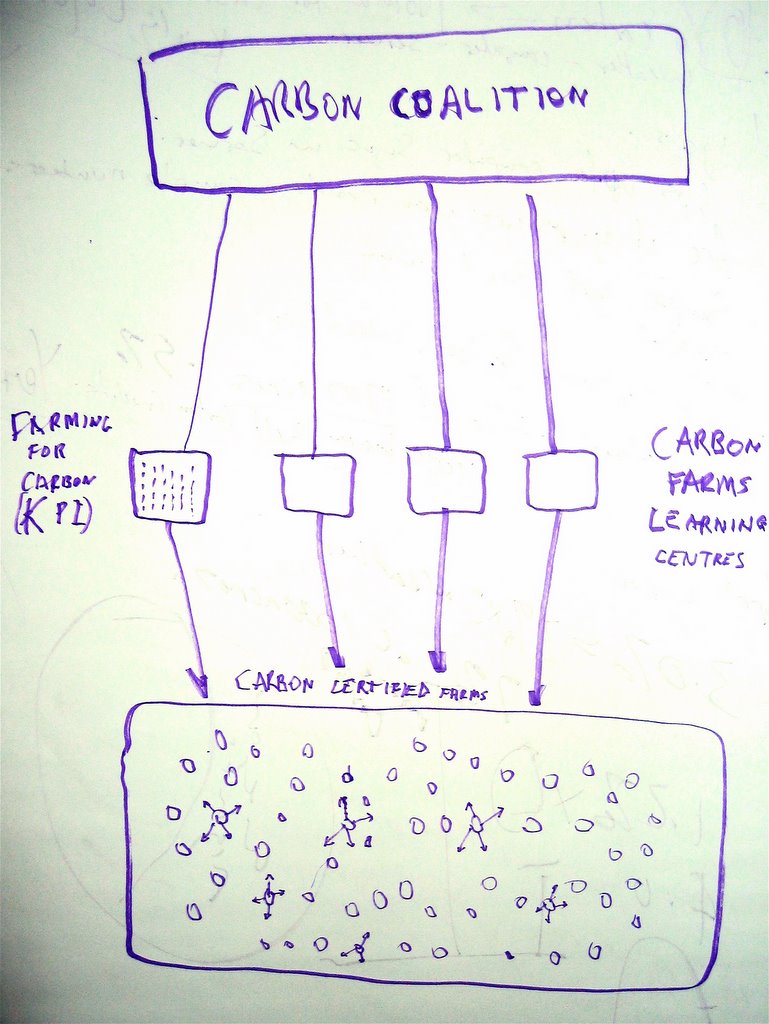
We started this blog as a way to share our thinking with our 'classmates' in the spirit of bouncing ideas off each other to help everyone have more creative ideas. So far we've bounced our early ideas (in the "Idols" post) and come up with a big idea, the Carbon Coalition. But the latter - while it has the potential to meet all the Catchment Management Authority's goals for ground cover and salination and species diversity and soil structure and community enhancement and water usage at point of landing and on and on - it's not a "farm system". In fact, it could easily be dismissed as just spin if you didn't understand it's potential to transform the face of the landscape forever, right across the nation, by harnessing as it does the profit motive to the cause of ecosystem regeneration.
But we must play the cards we are being handed. We need a "farm system", a whole of farm plan that is innovative (defined by the CMA as 'never been done before' - a big ask), replicable on other farms, can have a catchment-wide impact, positively impacts the triple bottom line, and meets the CMA's goals and objectives.

We said in our original submission for this program that we are "soil farmers" because the soil is the beginning and the end of it all. At Mass today Fr Frawley crossed our foreheads with damped ashes in a short ceremony (that usually takes place on Ash Wednesday, last week, but out here we couldn't get to town for it, so he did it on the First Sunday of Lent). The traditional words that the priest says when placing the cross on our foreheads are: "Remember man that thou art dust and unto dust thou shalt return." Adam was made from a lump of clay. Man came from the soil. And we all end up back there, pushing up daisies.
So "soil" stood out like the proverbial. Christine Jones has taught us the key indicator of soil health is carbon. So to be soil farmers we have to become carbon farmers.
Now growers are normally in the primary production business to grow commodities for sale on an open market. But once sequestering carbon in soils becomes and financial reality, the projected figures are so high (even when we halve them and halve them again) that production of produce could become secondary to the sequestering of carbon.
So we'll make the switch: our total farm plan will be based on sequestration.
Our KPI will be the percentage of carbon in our soils and the maintenance and improvement in those levels. We'll endeavour to become a Carbon Farm Learning Centre for our distirct which will bring in further revenue as agriculturalists and ordinary people come to visit and stay are learn about soil carbon and the paradigms of agriculture generally. Other farmers can decide, after taking a look at our place or any of the other district learning centres, whether they too will become Carbon Certified for sequestration. Another enterprise we could possibly launch on the back of carbon farming is mapping annd testing soils for carbon. Daniel and Olivia (his soil scientist girlfriend) have identified a mehodology that appears robust and reliable. We have some commercial-in-confidence concepts surrounding the testing issue, so I can't tell you the full story. Let it be said that we have a national network fo testing laboratories in mind.
And what does a Carbon Farm look like? There will be many variations. For instance, the US teams studying terrestrial sequestration are looking at wetlands. Some farms have them, some don't. But common carbon farming techniques are those which encourage 100% ground cover 100% of the time, and encourage deep-rooted perennials to enrich the soil. Techniques wwhich can be applied include rotational, time-controlled grazing, pasture cropping or advanced sowing, zero tillage cropping, permaculture, biodynamics, mulching, biosolids, nutrihumus, and stress free stock handling. There will be wildlife corridors to increase diversity of bird and small mammal life. And the entire enterprise will be planned as a biotic whole. As a Learning Centre the property will need meeting rooms and accommodation so more than the odd field day can be held. (There will be grades of Learning Centres.) The plan will accommodate Indigenous people's aspirations and the local community, with the value-added farmstay generating local employment.
SO that's it so far. We have the rest of March, April and most of May to refine our plan and nail it or chuck the lot away and start again.

Sunday, March 05, 2006

"We are part of the earth..."

"The chief product of the farm and of agriculture is persons," says Johnson D. Hill in Roots In The Soil. "Farming is not simply an economic 'money wage' activity; it is a way of life.... The farmer's work on the soil,as a aparticipation in nature's creative processes, must proceed in accord with nature's laws in order to be beneficial and successful. Learning in farm life... occurs by means of striking defeats, Nature is a serious and exacting master over its creatures. Discipline, patience, obedience, responsibility, and self-reliance are among the morally-worthy traits the farmer's mission engenders in him."

Native peoples, closer to the soil than western society, know this instinctively. "We are part of the earth and it is part of us... What befalls the earth befalls all the sons of the earth," said Chief Seattle in 1852.
It is part of a deep instinctive knowing that we all have and either respond to or shun out of ignorance or fear. But it gets you in the end. "The soil is the great connector of our lives, the source and destination of all." - Wendell Berry

Saturday, March 04, 2006

The frog that came to dinner


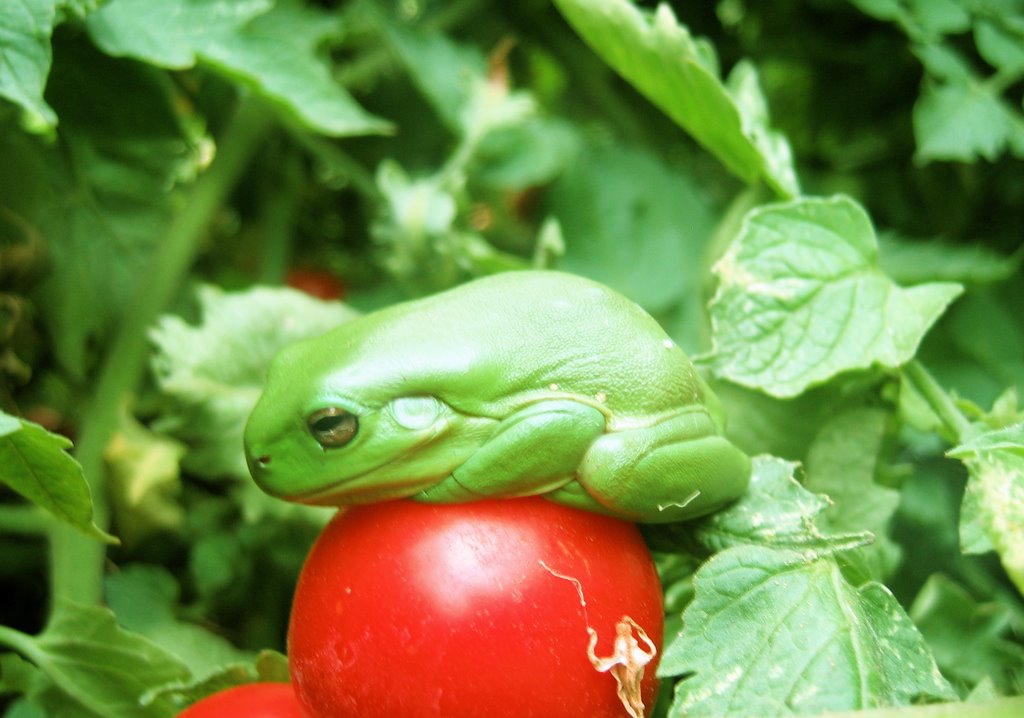
Frogs are a good omen. This one parked himself on a tomato and Louisa nearly picked him while gathering vegetable for last night's dinner. Frogs are an indicator of environmental health. Our visit by a Grey Shrike Thrush a few weeks ago was also important, according to an ecologist called Freudenberg who spoke to the CMA Farming Systems class this week. (I couldn't be there. Meetings in Sydney.) He told Daniel that these birds are key indicators of growing species diversity. It's arrival could mean we are on track with our reegeneration goals. Or it could mean we have had an unusual season.

Hear Ye! Hear Ye! WWW.CARBONCOALITION.COM.AU is launched

Even London's Town Crier is excited!
The official carbon coalition web address is now live and collecting supporters contact details. Tell your friends! This is the way to sign on to the new agricultural revolution - carbon credits in the soil.

The New Agricultural Revolution


There is a new agricultural revolution breaking out, as dramatic as the first one. This one sparked not by the Black Death, the bubonic plague that swept through Europe killing one third of the population in the 14th century, but by environmental disasters triggered by Global Warming.
The New Agricultural Revolution will see the ideology of soil health and cooperation with natural processes become the dominant paradigm as the old 'scientific agriculture' paradigm is swept away rapidly. The Spirit of Capitalism, the profit motive turns a whole generation of farmers into stewards of the soil. Instead of chasing diminishing returns, they are making more money by NOT ploughing and spraying and sowing and supering and spraying then harvesting, then burning the stubble.

We could be at one of those turning points of history, like the American Revolution or the storming of the Bastile. This is an incredible convergence of circumstances. Against a backdrop of widespread acceptance of the reality of Global Warming and the concept of sequestration... We have revelations about Carbon in Soil. We have world's-best-practice zero till methodologies in pasture cropping.. We have rotational grazing becoming common knowledge. We have a fifth column of regenerative farmers who are reaching critical mass. We have a wave of tree-change families, refugees from the city who are open to new ideas. We have government bodies tasked with saving the nation's greatest living asset, the soil. We have farmers hungering for returns that reflect the risks they take, holding properties that are valued far beyond their productive capacity under current management, distorting the economics such that it could be more attractive to those who inherit to sell than to go on working the land. And we have a generation of young people who don't want to inherit the title 'farmer' or 'grazier'.

We have catastrophic weather patterns creating a sense of urgency and soon to be near panic.

Suddenly we have this left of field solution. Soil Carbon Sequestration. It's madness. Impossible. Can't be done.

Remember the Mayor of New York consulting the Archbishop in the movie Ghost Busters? While ghosts terrorised the City and the EPA guy ranted "You're not going to believe these people. They are charlatans, frauds..." Mayor: "Get him out of here." The Mayor's thinking: "They're our only hope." And he's right.

There will be lots of EPA GUYS trying to convince the Mayor that we are charlatans. The EPA GUYS have got no answers. They have failed. So everyone else has to fail.

If we can focus the money energies sequestered in bank accounts of multinational polluters on the people responsible for managing our soils all around the world, especially impoverished countries who can come off such a low base and for whom the dollars would do so much good. If we can harness that energy to turn back the tide of destruction of soils and start a new paradigm. We can make history. We may only need to give it a nudge. Like the butterfly flapping its wings causing a tidal wave on the other side of the world, via quantum mechanics.

"There is a tide in the affairs of men,
Which, taken at the flood, leads on to fortune;
Omitted, all the voyage of their life
Is bound in shallows and in miseries.
On such a full sea are we now afloat,
And we must take the current when serves,
Or lose our ventures."
Julius Caesar, IV,iii,217

That's one vision of what we could be starting now. Even something smaller would be good to achieve.

And I believe when it's all done and dusted, they'll erect a statue to each one of you somewhere in the world. But that won't matter to you, because you'll always have mother nature whispering her thanks in your ear.