Visitors who have been following the Carbon Coalition's campaign to have soil carbon traded on world greenhouse emissions markets. We faced two hurdles: Hurdle 1 - getting access to global carbon markets (joining Kyoto). Hurdle 2 - finding a way to develop a soil carbon currency. Hurdle 1 is now behind us. The Federal Government buckled today on ABC TV. Hurdle 2 we are addressing tomorrow in our first meeting with scientific advisors.
In the words of Abe of Vermont: "Onwards!"
Sunday, November 12, 2006


Tuesday, November 07, 2006
We launch a new carbon business

PRESS RELEASE
7 NOVEMBER 2006
Carbon Credited brands will lead
A new consultancy has been launched to help marketers grasp the opportunities in Climate Change. The "Carbon Credited"™ Brands program is an advisory service that can help brand owners respond to the Greenhouse challenge and gain an early mover advantage.
“The time to start thinking about Global Warming is now, when your can gain maximum leverage and lead your category,” says Australia’s first Climate Change Marketing Consultant Michael Kiely. “You don’t have to spend $3 billion like Virgin to position your brand for a climate-changed world. In fact it’s better of you don’t because there are more enduring results to be had from a grassroots strategy that engages all stakeholders,” he says.
The "Carbon Credited"™ Brands program involves mapping an organisation's ‘carbon footprint’, developing options for becoming a 'carbon neutral' brand, developing opportunities for engaging a brand's stakeholders and helping them learn to manage Climate Change in their own lives. Companies engaged in the process of becoming carbon neutral can display the "Carbon Credited"™ stamp of approval.
Michael Kiely recently returned from a 3 week study tour of the USA meeting with the leading scientists working on the US Government’s Greenhouse solutions, meeting leading US and European carbon market authorities, and signing a deal with the Chicago Climate Exchange to trade in carbon credits from Australian producers. This visit caps off a year-long involvement with the issue at a grassroots level as Convenor of the Carbon Coalition Against Global Warming, a Greenhouse lobbying and trading operation.
“Both Australia and the US are close to introducing ‘cap and trade’ systems, despite their federal governments’ refusal,” says Michael Kiely. “The States in both countries are setting up mandatory ‘pollution tax’ systems that will have the same effect. Soon all companies will be forced to address their greenhouse emissions. Then the rush will be on.”
Companies that move early will stand out as being visionary and proactive.
Every brand should be thinking of its response to their customers' question: "What are you doing to save the world?" News Ltd, Ford, Dupont, and Virgin are among the leaders in this issue. They are going 'carbon neutral' - reducing their emissions or paying others to 'sequester' or lock up carbon dioxide in amounts equivalent to their emissions. BP, Westpac, Origin Energy, Visy and IAG are taking a leadership role.
The front-foot approach involves the following: 1. Engage your CEO and Board. (McKinsey says: "The way a company manages its carbon exposure could create or destroy shareholder value." Goldman Sachs says, "Climate change is a topic that should be on the agenda of every Board of Directors.") 2. Audit your emissions. 3. Assess your potential for reductions by operational changes. 4. Estimate the offsets you will need to purchase to bring your "carbon footprint" down. 5. Engage your stakeholders - staff, suppliers, customers, shareholders - in the process.
There are pitfalls to avoid: 1. As with any new market, there are many opportunists selling snake oil. 2. Some 'abatement offsets' being sold are 'junk', ie, not fit for the purpose for which they are offered for sale. 3. Some could damage brands choosing them when green groups reveal what is going on behind them. 4. Companies that indulge in "greenwashing" (making a token effort, hoping to spin it out into an acceptable image of action) will be unmasked, and their deception will do them damage.
“There’s no time to lose. This issue is getting hotter,” says Michael Kiely.
ABOUT MICHAEL KIELY
Michael Kiely is principal of Michael Kiely Marketing. He served until 2006 as a national director of the Australian Direct Marketing Association and was inducted into the Australian Direct Marketing Hall of Fame in 2001. He is former Chairman of Boomerang Integrated Marketing & Advertising.
FOR MORE INFORMATION Call 0417 280 540. Or email me at Michael@michaelkielymarketing.com.au.

Sunday, November 05, 2006
A Day In This Life
 THE WALK
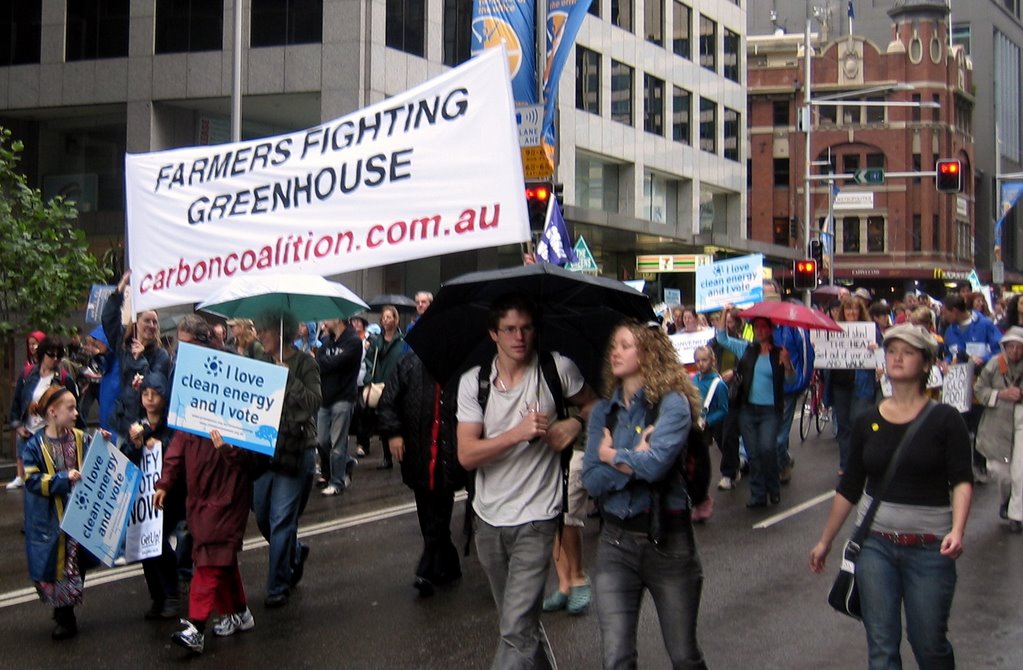
It was a day like any other day. I started out last Saturday at 5.15pm sending press releases to the media about our "Farmers Fighting Greenhouse" banner in the Walk Against Warming later that day. Then there was meeting up with the people who made the banner for me (because I didn't want to leave my daughter Rachel at home alone on the first day with her new baby Brodie (Lousia on the farm keeping lambing ewes alive, Daniel somewhere climbing rocks to forget, Jessica somewhere else aattending to her growing business empire). Kevin and Leisel and Marc. And then the walk (see http://carboncoalitionoz.blogspot.com). Then rush home to blog the photos of the march, then rush off to the wedding of my friends Simon and Linda, who had a terrific ceremony and great speeches, especially by Billy and his other son (sorry, I forgot his name, but he's a great writer).
 THE NEW GRANDSON
 MARC POP in PARADE GEAR
 LEISEL
 SIMON AND LINDA
Monday, October 30, 2006
Alternative agriculture must unite
Australian agriculture is in crisis. So since when has it not been in crisis? The first colonial farmers nearly starved to death and had to be fed by government handouts. Aborigines, rabbits, drought, wheat rust… always something.
But this latest crisis is different, because the foundations of our agricultural system have been eroded and weakened. This has made us vulnerable to shocks from outside – such as Climate Change.
The foundations of agriculture are the ecosystem, the natural resource base. This is made up of the soil and all the living and dead things it depends upon and that depend upon it, including water, vegetation, microbes, insects and on up the food chain. It’s not being overdramatic to say that the system that sustains the production of food and fibre in this country are breaking down.
Most people don’t know this, even those living and working on the land. But those that do, when they turn to alternative agriculture, find a bewildering array of options. As things get worse, more solutions emerge. There is Holistic Resource Management, Natural Sequence Farming, Biological Farming, Biodynamics, Keyline Farming, Pasture Cropping, Permaculture, Composting, and on it goes. None of them contradicts any other. They are broadly based on the same principle in that they seek to mimic Nature’s processes.
No one of them has risen to sweep all before it and solve all the problems of agriculture. Nor is one of them likely to become the dominant new paradigm, replacing the old system. There are three reasons for this:
1. It takes time for new ideas to become popular. Usually more than a generation. Newton’s physics dominated modern science for 300+ years before Einstein. Old ideas live on long after they’ve lost their relevance.
2. All these alternatives offer a diversity of solutions to he same problem. This diversity divides the already small market into even smaller segments.
3. The market is also diverse. Different styles of regenerative farming will appeal to different types of farmers.
The reality of the marketplace for alternative agriculture is divided in another way: by the users themselves. The tend to mix and match from the selection available, The proponents of these alternatives in many cases either ignore or disparage the others. But they can’t ignore the fact that customers (farmers) will drive the market and the result will be combinations of techniques, each as different as each farm and each farmer.
Here lies the opportunity for alternative agriculture to respond to the marketplace by presenting itself as a whole solution with many parts.
As a collective, the marketplace presence of the whole would far outperform that of the parts. In the same way, the political presence of a body representing the growing ranks of ‘natural’ farmers would tell a different story about agriculture to the government and the community, a story that challenges the stereotype of the farmer as environmental vandal. Instead of a random series of individual events to promote each separate discipline, a jointly-funded ‘trade show’ that visits every farming district and uses effective promotion would give each of the alternatives more exposure to the market than any other option.
Saturday, October 28, 2006
Future Shock has arrived
It’s rarely that a professional cynic, which is what a journalist is, loses their cool and explodes all over the page of a quality newspaper like the Sydney Morning Herald. Paul Sheehan did just that this week. His irritation? The disaster unfolding on farms across Australia and the federal government’s wilful refusal to acknowledge climate change as the underlying cause. (http://www.smh.com.au/news/scorchedearth/we-fiddle-as-the-continent-turns-to-dust/2006/10/22/1161455605817.html)
The canary in the coal mine is “a highly innovative grazing enterprise” called Coombing Park, near Orange. George King “inherited a badly eroded property and turned it into a showpiece, using holistic landcare techniques that are absent from most rural businesses.” But this drought forced him to reduce his stocking rate to 40 per cent of peak capacity. That was last year. This year they are destocking to 20%. That’s below the cost of production. He’s going broke.
“Even the best farmers are suffering now. The bush is dying. The towns, the landscape, the rivers are being killed by this climate change."
City commentators usually chorus, at these times: “Get the old-fashioned cockies off the land.” The assumption is that good management will solve the recurring crises in rural areas will be solved. But now the peak performance farmer is being crushed. And Australian farmers are the best in the world. Their European and American counterparts are payed to get out of bed by their governments.
George King believes this is no ordinary drought. He sees an unusual “compounding effect." It is the Climate Change effect: "As more country is stripped bare and dried out we expose more soil. This is releasing more carbon into the atmosphere. Organic carbon levels are falling, and the soil is losing its colour. There are more fires than ever because the dry summers are adding enormous amounts of carbon into the atmosphere and creating more bare ground.” So when it does eventually rain the topsoil will be washed down the gullies, creeks and rivers.
If George King is in trouble, you can bet everyone else is worse off. Because George uses holistic land management practices that give the soil and grasses the best chance to recover between grazings. But the carbon imbalance is turning grasslands into deserts, he says. "Pretty soon we will be able to see the great deserts from the Great Dividing Range."
Apologists for the Government’s constirpated response to the environemental crisis are still brazenly trotting out their pseudo-scientific explanations and spin. The Institute of Public Affairs’ Jennifer Marohasy is content to say Climate Change can’t be responsible for the drought because some institute on Colorado announced that things should be getting wetter, not drier as the globe warms. (http://www.onlineopinion.com.au/view.asp?article=5076) But even a schoolchild knows that the world’s scientists agree on the following: some parts will get wetter, some will get drier.
Yet her website proclaims: “Concerned that public policy on environmental issues is increasingly driven by moral crusading, rather than objective science or need, Jennifer works to provide an important counterpoint in public debate and discussion.” The morality of continuing to push the “Climate Denial” line of conservative propaganda is breathtakingly bleak. Albert Einstein said repeating the same action over and over while expecting a different result was a definition of insanity. Sheehan explains that these lunatics have been allowed to flourish and peddle their witchcraft because of a failure of political will on the Opposition benches.
Where does that leave us? Stuck with a Prime Minister who will put ideology before the public good? Who had to be dragged kicking and screaming to admit warming is real? Whose government gagged CSIRO scientists when they spoke out about the danger? Whose Government allows the coal mining and power generation industry to write policy for ministers? Who’s government robbed the Australian Greenhouse Office of its independence and brought it in under the Minister of Natural Resources? The same Greenhouse Office which now parrots the Government’s propaganda line: “We are meeting the greenhouse challenge?”
Something has got to give. Refusing to ratify Kyoto is like arguing about he price of lifeboats on the Titanic. The Federal Government must immediately introduce a cap and trade scheme and the markets must immediately settle on an averaging regime for trading soil carbon credits. Because the soil is the only sink which can start sequestering carbon now, which is available in large amounts, and which is inexpensive to use for sequestering.
Route 66: from Chicago to LA
(For those just joining: You are entering Part 3 of the story of an epic journey in search of the Philosopher's Stone, aka. carbon. We are the founders of the Carbon Coalition Against Global Warming, seeking to have the carbon farmers can lock up in soils accepted for carbon credits. We have come to America to discover what measurement methodology the US is likely to run with once it joins the global market so we can start using the same approach. The scientists and experts we met on the study tour are introduced via that link.)
WE ARE LINCOLNED
On to Ohio State University where we stayed in a hotel named after a professor of marketing named Blackwell whose books were on display in the foyer. This was the best hotel experience we had duing our epic journey. The Concierge drove me twice to a camera shop to have my digital download card reader fixed and then replaced. He waited around while I was sold stuff I didn't need, then drove me back, in the hotel's Lincoln Continental. Would not take a tip. And was an interesting man to boot. He and his wife had run an elegant corporate mansion on an estate for 15 years before retiring and travelling for a year. They loved Australia. I invited them to Uamby should they ever reach our shores again. He is an intelligent gent.
In the constant battle to eat American food, I asked one night would the chef accept a challenge - to make a desert out of brie, stewed fruit and pastry. He did it, and it was magnificent. We called it Heckerburn Brie Carbonara.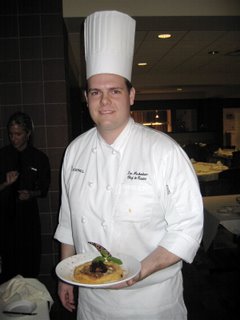 Most of the staff in the hotel were students at OSU, which was refreshing. On the first night, we had a drinks waiter who asked "How are you tonight?" To which I answered "Stuffed. How are you?" He immediately got down on his haunches so we were at face level and repeated, "I'm stuffed, too." He can't have known what 'stuffed' meant, but as a major in Russian Literature and World Politics he had the nouse to figure it out from the context. getting down to our level was a master stroke of service. We were sick of "servile service" by this timeand someone treating us as an equal was just what the Aussies wanted. He is destined to a career in international politics, and he has the first ingredient: the human touch. The hotel was impressive, but inexpensive (thanks Expedia). Professor Lal seemed to think we were living it up staying there. It was part of the Fisher Business School which took the rather unusual position in its marketing of proclaiming that it was ranked 13th in the world by Business Week magazine. Now 13th is not a good look.
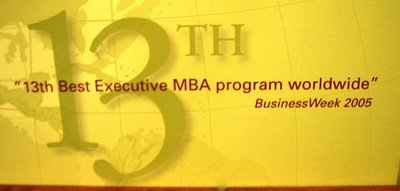 Why not choose to frame the ranking around American business schools? They’d at least be top 10. And who ranks Business Week? Fortune would have been better, or the Wall Street Journal. Strange, such clumsy marketing in a hotel named for a marketing ‘guru’. Here at OHU we met Professor Lal, the big kahuna of soil carbon scientists. He was the man we came to see. He gave us 2 books, 1 hour and a half, a lot of help and the thrill of hearing ourselves referred to as 'colleagues' when he was telephoning the CEO of the Chicago Climate Exchange to tee up and appointment for us.
Next stop Chicago, where we stayed in a business hotel out in the boonies, closer to the airport than to town. We encountered no one of enduring interest except Michelle from the japanese Tepenyaki who was one of those Americans who love Australians and gave Louisa a hug and gave us a couple of seats in a crowded restaurant. We also met Mike Walsh (SVP CCX) who offered us a deal on 25,000 acres of no-til soil and an unnamed trade official from an unnamed country who gave us advice as to how to do business in Al Capone's city. He has to be unnamed and unknown because by this time an unnamed government was trying to discourage us from pursuing carbon credits trading in deifiance of its official policy against what it calls 'carbon taxes'.

While in Chicago we ate at a very nice Chinese restaurant across the road from a blues club called the something “mines” where we heard some solo artist playing to an empty room, then two bands in different rooms, laying it down like funkytown. Louisa decided to have a dance, I had my computer in my knapsack and wasn’t inclined to leave it. So she grabbed the nearest guy and danced with him. He was from Baltimore and probably thought his ship had come in. I was able to observe, at dinner, an elderly couple who were having relationship difficulties. They looked cultivated. She had a sweet face and he was bitter about life and his physical infirmities, which meant she had to help him with certain things. He spat at her, without spitting. At one stage she got up to walk out and he said, in a voice like a little boy, "Please don't go." Foolish man.
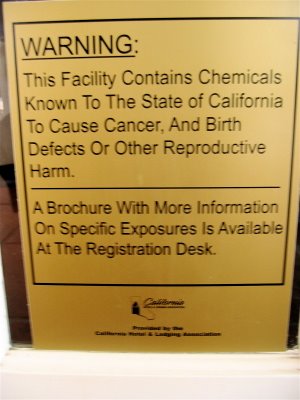
Finally we flew to San Diego where we had 3 massage treatments at the Chopra Centre in La Costa (a resort) while staying at the Four Seasons Resort. I hated it. Pimp rich. Trump trash. While Mexican maids 'manned' a picket line, hiding their faces and copping abuse from cabbies - for asking for a few bucks an hour or for being Mexican. They did have the foresight to warn us by signs that the place was toxic.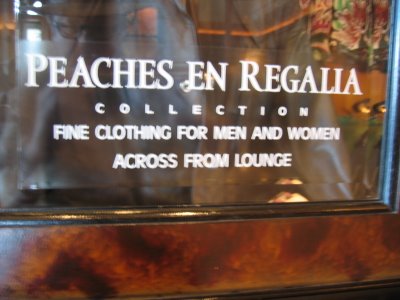
The resort’s haute couture boutique was irreverently called “Peaches En Regalia” which would have Zappa spinning in 10/8 time in his grave. The irony. Has his wife licenced this outrage?
 God's contempt for money is evident by the people he gives it to. We enjoyed one trip with a mandolin playing cabbie. But California looks like a movie lot - all those houses clambering over the ridgelines waiting to be shaken off when the fault line tears again. (Long overdure, it will be a big one.)
20 flights in 20 days... whew! America is the most highly evolved material culture in the history of humanity. Some of its people are also highly evolved. Some are not.
 Like the guy overheard me criticising the level of moral corruption in the US government system (the streets of Washington are slippery with sleaze) and started taking photos of me with his cell phone (presumably to report me as a terrorist suspect)> I took photos of him to return the favour and he ducked down behind his seat each time.
Final ray of hope for American civilisation. This sweet young girl personing the Kinky Friedman For Governor booth at Texas A&M. She was sitting in the sun, no hat or water. But so sweet, and her boyfriend looked sweet too. After she got through personing, they went off holding hands. Everyone on that campus looked sweet, like they were all in the military. There were 3 normal looking kids there. We got lost walking across campus. Lost in the sweetness of American life and light. Lost in a wilderness of white people being white and black people being black and other people being other colours. We saw no poverty but poverty of spirit. We saw no crime but the crime of neglect. We saw no violence but the violence we do to each other thoughtlessly when we fail to love wholly. We saw no hope but the hope of mankind. We saw no salvation but the salvation of the damned. We saw no end but the ending of all beginnings and the beginning of the end.

God, Please Bless America and all those people we met. Thank you for letting us see a little of your world.
WE ARE LINCOLNED
On to Ohio State University where we stayed in a hotel named after a professor of marketing named Blackwell whose books were on display in the foyer. This was the best hotel experience we had duing our epic journey. The Concierge drove me twice to a camera shop to have my digital download card reader fixed and then replaced. He waited around while I was sold stuff I didn't need, then drove me back, in the hotel's Lincoln Continental. Would not take a tip. And was an interesting man to boot. He and his wife had run an elegant corporate mansion on an estate for 15 years before retiring and travelling for a year. They loved Australia. I invited them to Uamby should they ever reach our shores again. He is an intelligent gent.
In the constant battle to eat American food, I asked one night would the chef accept a challenge - to make a desert out of brie, stewed fruit and pastry. He did it, and it was magnificent. We called it Heckerburn Brie Carbonara.
 Most of the staff in the hotel were students at OSU, which was refreshing. On the first night, we had a drinks waiter who asked "How are you tonight?" To which I answered "Stuffed. How are you?" He immediately got down on his haunches so we were at face level and repeated, "I'm stuffed, too." He can't have known what 'stuffed' meant, but as a major in Russian Literature and World Politics he had the nouse to figure it out from the context. getting down to our level was a master stroke of service. We were sick of "servile service" by this timeand someone treating us as an equal was just what the Aussies wanted. He is destined to a career in international politics, and he has the first ingredient: the human touch. The hotel was impressive, but inexpensive (thanks Expedia). Professor Lal seemed to think we were living it up staying there. It was part of the Fisher Business School which took the rather unusual position in its marketing of proclaiming that it was ranked 13th in the world by Business Week magazine. Now 13th is not a good look.
 Why not choose to frame the ranking around American business schools? They’d at least be top 10. And who ranks Business Week? Fortune would have been better, or the Wall Street Journal. Strange, such clumsy marketing in a hotel named for a marketing ‘guru’. Here at OHU we met Professor Lal, the big kahuna of soil carbon scientists. He was the man we came to see. He gave us 2 books, 1 hour and a half, a lot of help and the thrill of hearing ourselves referred to as 'colleagues' when he was telephoning the CEO of the Chicago Climate Exchange to tee up and appointment for us.
Next stop Chicago, where we stayed in a business hotel out in the boonies, closer to the airport than to town. We encountered no one of enduring interest except
 Michelle from the japanese Tepenyaki who was one of those Americans who love Australians and gave Louisa a hug and gave us a couple of seats in a crowded restaurant. We also met Mike Walsh (SVP CCX) who offered us a deal on 25,000 acres of no-til soil and an unnamed trade official from an unnamed country who gave us advice as to how to do business in Al Capone's city. He has to be unnamed and unknown because by this time an unnamed government was trying to discourage us from pursuing carbon credits trading in deifiance of its official policy against what it calls 'carbon taxes'.

While in Chicago we ate at a very nice Chinese restaurant across the road from a blues club called the something “mines” where we heard some solo artist playing to an empty room, then two bands in different rooms, laying it down like funkytown. Louisa decided to have a dance, I had my computer in my knapsack and wasn’t inclined to leave it. So she grabbed the nearest guy and danced with him. He was from Baltimore and probably thought his ship had come in. I was able to observe, at dinner, an elderly couple who were having relationship difficulties. They looked cultivated. She had a sweet face and he was bitter about life and his physical infirmities, which meant she had to help him with certain things. He spat at her, without spitting. At one stage she got up to walk out and he said, in a voice like a little boy, "Please don't go." Foolish man.
Finally we flew to San Diego where we had 3 massage treatments at the Chopra Centre in La Costa (a resort) while staying at the Four Seasons Resort. I hated it. Pimp rich. Trump trash. While Mexican maids 'manned' a picket line, hiding their faces and copping abuse from cabbies - for asking for a few bucks an hour or for being Mexican. They did have the foresight to warn us by signs that the place was toxic.

The resort’s haute couture boutique was irreverently called “Peaches En Regalia” which would have Zappa spinning in 10/8 time in his grave. The irony. Has his wife licenced this outrage?
 God's contempt for money is evident by the people he gives it to. We enjoyed one trip with a mandolin playing cabbie. But California looks like a movie lot - all those houses clambering over the ridgelines waiting to be shaken off when the fault line tears again. (Long overdure, it will be a big one.)
20 flights in 20 days... whew! America is the most highly evolved material culture in the history of humanity. Some of its people are also highly evolved. Some are not.
 Like the guy overheard me criticising the level of moral corruption in the US government system (the streets of Washington are slippery with sleaze) and started taking photos of me with his cell phone (presumably to report me as a terrorist suspect)> I took photos of him to return the favour and he ducked down behind his seat each time.
Final ray of hope for American civilisation. This sweet young girl personing the Kinky Friedman For Governor booth at Texas A&M. She was sitting in the sun, no hat or water. But so sweet, and her boyfriend looked sweet too. After she got through personing, they went off holding hands. Everyone on that campus looked sweet, like they were all in the military. There were 3 normal looking kids there. We got lost walking across campus. Lost in the sweetness of American life and light. Lost in a wilderness of white people being white and black people being black and other people being other colours. We saw no poverty but poverty of spirit. We saw no crime but the crime of neglect. We saw no violence but the violence we do to each other thoughtlessly when we fail to love wholly. We saw no hope but the hope of mankind. We saw no salvation but the salvation of the damned. We saw no end but the ending of all beginnings and the beginning of the end.

God, Please Bless America and all those people we met. Thank you for letting us see a little of your world.
Saturday, October 14, 2006
From LA to DC and back again, Part 2
We flew from College Station to Dallas, Texas and then to Albuqurque, New Mexico to attend the Southwest Sequestration Partnership workshop. We booked in a Marriott Courtyard hotel which managed to lose our laundry and return it item by item.  But they had a cook cooking fresh omlettes in the breakfast room - yum! Food was a problem in the US - we couldn't eat a lot of it. But at this hotel we had two good meals: the breakfast omlettes and the Duck Rolls. I asked to see the chef and congratulate him. He was chuffed. We ordered another round of the Chinese delight.
 Sitting nearby was a young woman reading a magazine and talking to her friend, one of the waitresses. She called out some facts about Global Warming, and our ears pricked up. It turns out she is reading the recent edition of The Economist we had been searching in all the newsagencies for since we were referred to it by Sue Capalbo, the team leader at the Big Sky Partnership, at Montana State U. She gave it to us. More coincidences, more spooky stuff. We gave her a kangaroo pin. She seemed impressed. Her name was Jessica and she is a prodigious reader.
 While in Albuqurque we spent a day with Peter Holter, the director of marketing with Holistic Management International, the organisation set up to promote the decision-making model invented by Allan Savory. It launched rotational grazing into popular consciousness. Peter took us in hand and showed us Old Town in Albuqurque and the rest of the city, especially the domestic building styles. The range towering over the city reminds me of Alice Springs. Peter is a fascinating fellow-refugee from the advertising business. We briefed Peter on the Carbon Coalition because Holistic Management is a basic carbon farming methodology, and we agreed to work together to creat opportunities for HM.
We then took a 5 hour flight via Dallas and Philadelphia to Burlington, Vermont. Hired a car, and drove for an hour north to join Abe Collins and his friends to launch the first overseas chapter of the Carbon Coalition. This was the most personally rewarding part of the journey.
 Abe was the first overseas member - he is a share farmer (dairy) at Swanton, Vermont. I will blog the farm on the We loved the energy and passion of Abe and the grounded dynamism of his amazing partner Kailia. She is an artist. They have a We ate real food - fresh organic vegetables and home grown meat, all wonderfully prepared in stock that didn't come from a supermarket. Abe has the fire in the belly. He is widely-read and he has a head full of ideas. He exasperates his wife because he can become so engrossed in his ideas that he forgets her. Ie. he is a normal male. I left a copy of my book lying around and I think he had a look at it... Kailia is a youthful, unflappable, intense person. She could have been one of Joni Mitc
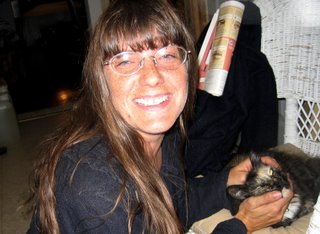 hell's Ladies of the Canyon, without the cliche West Coast cliches. Her achievements are all around her: Abe, daughter Margo, cat Apple, dog Cider.
Margo is amazingly articulate - she speaks at an adult level. Her genetic pool was a rich one. The do not have television. They read books. They make cider. The live a real life.
 We caught a glimpse of Vermont suburban culture when we attended a housewarming cocktail party at Kailia's parents' new home in Swanton. We met real estate agents and doctors and distribution agents and women who home school their children. Kailia's Father is a retired stockbroker. Her Mother is a beautiful woman.
They love Opera and classical music. They have a wonderful view of Lake Champain where the American Navy defeated a British invasion force.
American plans for the War of 1812 included gaining control of Lake Champlain and the Great Lakes. Lieutenant Thomas Macdonough commanded the U.S. naval fleet on Lake Champlain. The two fleets finally met on September 11, 1814. (9/11) Macdonough positioned his fleet in a line with an anchoring system rigged with spring lines that allowed the vessels to be turned end-to-end to bring fresh guns on the opposite side of the ship to bear on the enemy should the guns on the original side become disabled. The two fleets were nearly matched in size and firepower. The battle raged for two and-a-half hours and many died. Thanks to their spring lines the American fleet ultimately defeated the Royal Navy, and the British army returned to Canada.
More to come....
 But they had a cook cooking fresh omlettes in the breakfast room - yum! Food was a problem in the US - we couldn't eat a lot of it. But at this hotel we had two good meals: the breakfast omlettes and the Duck Rolls. I asked to see the chef and congratulate him. He was chuffed. We ordered another round of the Chinese delight.
 Sitting nearby was a young woman reading a magazine and talking to her friend, one of the waitresses. She called out some facts about Global Warming, and our ears pricked up. It turns out she is reading the recent edition of The Economist we had been searching in all the newsagencies for since we were referred to it by Sue Capalbo, the team leader at the Big Sky Partnership, at Montana State U. She gave it to us. More coincidences, more spooky stuff. We gave her a kangaroo pin. She seemed impressed. Her name was Jessica and she is a prodigious reader.
 While in Albuqurque we spent a day with Peter Holter, the director of marketing with Holistic Management International, the organisation set up to promote the decision-making model invented by Allan Savory. It launched rotational grazing into popular consciousness. Peter took us in hand and showed us Old Town in Albuqurque and the rest of the city, especially the domestic building styles. The range towering over the city reminds me of Alice Springs. Peter is a fascinating fellow-refugee from the advertising business. We briefed Peter on the Carbon Coalition because Holistic Management is a basic carbon farming methodology, and we agreed to work together to creat opportunities for HM.
We then took a 5 hour flight via Dallas and Philadelphia to Burlington, Vermont. Hired a car, and drove for an hour north to join Abe Collins and his friends to launch the first overseas chapter of the Carbon Coalition. This was the most personally rewarding part of the journey.
Abe was the first overseas member - he is a share farmer (dairy) at Swanton, Vermont. I will blog the farm on the We loved the energy and passion of Abe and the grounded dynamism of his amazing partner Kailia. She is an artist. They have a We ate real food - fresh organic vegetables and home grown meat, all wonderfully prepared in stock that didn't come from a supermarket. Abe has the fire in the belly. He is widely-read and he has a head full of ideas. He exasperates his wife because he can become so engrossed in his ideas that he forgets her. Ie. he is a normal male. I left a copy of my book lying around and I think he had a look at it... Kailia is a youthful, unflappable, intense person. She could have been one of Joni Mitc hell's Ladies of the Canyon, without the cliche West Coast cliches. Her achievements are all around her: Abe, daughter Margo, cat Apple, dog Cider.
Margo is amazingly articulate - she speaks at an adult level. Her genetic pool was a rich one. The do not have television. They read books. They make cider. The live a real life.
 We caught a glimpse of Vermont suburban culture when we attended a housewarming cocktail party at Kailia's parents' new home in Swanton. We met real estate agents and doctors and distribution agents and women who home school their children. Kailia's Father is a retired stockbroker. Her Mother is a beautiful woman.
They love Opera and classical music. They have a wonderful view of Lake Champain where the American Navy defeated a British invasion force.
American plans for the War of 1812 included gaining control of Lake Champlain and the Great Lakes. Lieutenant Thomas Macdonough commanded the U.S. naval fleet on Lake Champlain. The two fleets finally met on September 11, 1814. (9/11) Macdonough positioned his fleet in a line with an anchoring
 system rigged with spring lines that allowed the vessels to be turned end-to-end to bring fresh guns on the opposite side of the ship to bear on the enemy should the guns on the original side become disabled. The two fleets were nearly matched in size and firepower. The battle raged for two and-a-half hours and many died. Thanks to their spring lines the American fleet ultimately defeated the Royal Navy, and the British army returned to Canada.
More to come....
Friday, October 13, 2006
We meet the sweetest people in the USA
We were feeling blocked with the soil carbon campaign. We needed more information, we were getting nowhere. We needed to know the real story. No amount of web surfing was going to tell us what we needed to know.  But we can't afford to spend $25,000 on a study tour of the US... I kept putting off contacting the people we wanted to visit until it was too late... and then we went anyway. We were accompanied by Archangel Michael who cleared the path and opened doors for us. We got to meet every expert I had on the list! I report on the experts on the Carbon Coalition blogsite. But we also met some wonderful people who changed our opinion of America. We started in Washington DC where the Concierge had a Marty Feldman eye and John Cleese manner (a la faulty towers) and the most interesting person we met was a squirrel who lived in the oak tree outside our expensive B&B. Then there was Rob from the Bison Farm selling buffalo jerky and steaks and sausages at the farmers' market at Dupont Circuit in
 Washington (more about his operation in a later post). Rob and his family run - on 200 acres, 100 of it wilderness, a herd of bison, plus goats, pigs, turkeys, chickens, and they slaughter and sell ther meat. They sell on contract to food outlets, by mail order to consumers, and at farmers' markets. This model is tipped to become more popular as agriculture polarises between the 'get big or get out' and "get small and hip". There will be some lovely photos of Rob's operations on the post. After attending a conference in a hotel for 2 days - a gabfest about carbon markets where we met the country's leading movers and shakers, including California Governor Scwarzenegger's environment guy and the senior vp of the Chicago Climate Exchange.

We next flew to Bozeman, Montana to join the Big Sky Sequestration Partnership while they reviewed the last 2 years of operations and planned for the next two years.
At the airport we caught a glimpse of the monstrous trucks the Montanans use to consume more than their share of the world's energy resources and to emit more than their fair share of emissions.
More than half the vehicles on the road were "SUVs" - sports utility vehicles. American-made vehicles do not meet the consumption and emission standards demanded of automotive makers by the Australian Government.
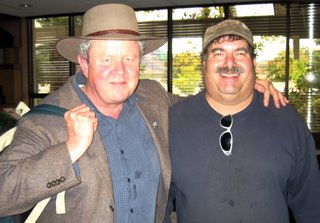 At Boezman we met Jack Morris, a dying breed. He is an agricultural technician or a hired hand. He told us that the good farm land thereabouts was being sold off to lifestyle buyers because the farmers can't make ends meet. He knows 50 farmers, and he's know cases of suicide, marriage breakdown. When we started our conversation he was very negative about carbon credits and climate change. But once he heard about the carbon in agricultural soils, he was converted immediately to our cause. Jack Morris of Boezman, Montana is starting a chapter of the Coalition! (I spilled soup on my shirt at lunch. But we weren't drinking. Just happy.)
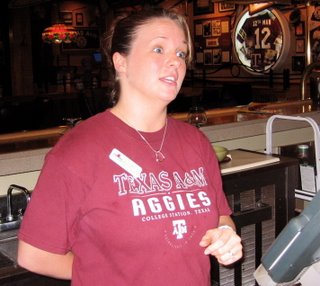
Next we went to Texas, to College Station, a town completely dominated by Texas A&M University. There we ate a meal at Applebee's family diner and bar. We drank Maragrita's made for us by Lauren who is a vet science student and is married, though she's only 23 years old. She told us her degree will cost her $60,000 to $80,000. Students have to go far into debt to get an education.
Texas A&M was originally Texas Agricultural and Mechanical College. There were so many people in military uniforms on campus, that it felt like Fort Custer. There were nothing but clean cut kids, happy to be known as "Aggies", and everyone wore the University Tshirts identifying them as either an Aggie or an Aggie Mom, Dad, Sister, Husband, Wife (there was a Tshirt for the entire clan). It was home game Friday when we arrived and town was full of p arents come to see their expensive children.
We met up with Robert in Sarge's Army/Navy Surplus across the road from the campus. He knew about rotational grazing, "That's where you move them after 25 days," he said. "I know about that." Not quite, but he was full bottle on perennials and grazing management. He sold me some bootpolish and a brush because my "instant shine" dispenser was confiscated while getting on a plane - in case I blew them up with it. We had lunch at the Kyoto Japanese restaurant, next door. (Spooky.)
Robert wanted to talk, so much so he left his customers standing there with their military haircuts and their Army/Navy Surplus purchases for what seemed like ages while we tried to escape. He was such a nice fella, but we felt kind of bad for his customers. They were all nice people, too. Everyone's nice in America, except the people who criticise the Government. The lady serving in the Italian fast food outlet came around from behind the counter to hug Louisa. "I just love you people," she said. I guess when you go to war with people they feel grateful.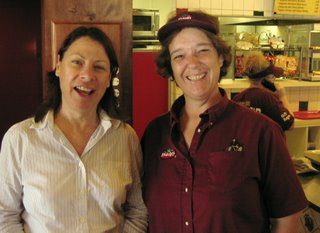 I didn't mention that we were against the war, to anyone. In fact we were careful what we said in public because this guy sitting behind me in one of the airports started taking photos of me with his phone after I made remarks about the trouble the Gov ernment was in over a few things... (The newspapers say they are protecting a pedophile Congressman, selling chairmanships of Congressional Committees and allowing judges to take campaign contributions from parties to litigation for whom they were invariably finding. And the media - even Fox News - say the Government tells lies and debauches public institutions. The President's now got the lowest approval rating in history, lower than Richard Nixon, and they are calling him "The Worst President In History". If this is so, he sure has stuffed things up for all these nice people. They won't get out of Iraq without a Viet Nam-sized humiliation. And that's bad for Democracy and Freedom and the American Constitution.) I like President Bush. He may not be too smart. But he's not dumb like everyone says. He's just a Texan. T for Texan, T for Tough, T for T-bone.
T for Trouble. T for Tuxedo.
Look this is taking a whole lot longer than I thought it would and I gotta do some work. We'll pick up at Albuqurque, New Mexico next time.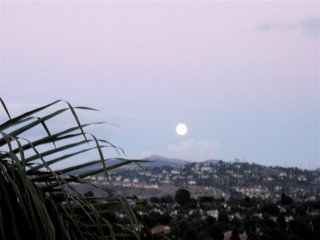 Meanwhile I'll leave you with this view from the window of our hotel in San Diego, of the moon coming up full and bright on another balmy California night.
 But we can't afford to spend $25,000 on a study tour of the US... I kept putting off contacting the people we wanted to visit until it was too late... and then we went anyway. We were accompanied by Archangel Michael who cleared the path and opened doors for us. We got to meet every expert I had on the list! I report on the experts on the Carbon Coalition blogsite. But we also met some wonderful people who changed our opinion of America. We started in Washington DC where the Concierge had a Marty Feldman eye and John Cleese manner (a la faulty towers) and the most interesting person we met was a squirrel who lived in the oak tree outside our expensive B&B. Then there was Rob from the Bison Farm selling buffalo jerky and steaks and sausages at the farmers' market at Dupont Circuit in
 Washington (more about his operation in a later post). Rob and his family run - on 200 acres, 100 of it wilderness, a herd of bison, plus goats, pigs, turkeys, chickens, and they slaughter and sell ther meat. They sell on contract to food outlets, by mail order to consumers, and at farmers' markets. This model is tipped to become more popular as agriculture polarises between the 'get big or get out' and "get small and hip". There will be some lovely photos of Rob's operations on the post. After attending a conference in a hotel for 2 days - a gabfest about carbon markets where we met the country's leading movers and shakers, including California Governor Scwarzenegger's environment guy and the senior vp of the Chicago Climate Exchange.

We next flew to Bozeman, Montana to join the Big Sky Sequestration Partnership while they reviewed the last 2 years of operations and planned for the next two years.
At the airport we caught a glimpse of the monstrous trucks the Montanans use to consume more than their share of the world's energy resources and to emit more than their fair share of emissions.
More than half the vehicles on the road were "SUVs" - sports utility vehicles. American-made vehicles do not meet the consumption and emission standards demanded of automotive makers by the Australian Government.
 At Boezman we met Jack Morris, a dying breed. He is an agricultural technician or a hired hand. He told us that the good farm land thereabouts was being sold off to lifestyle buyers because the farmers can't make ends meet. He knows 50 farmers, and he's know cases of suicide, marriage breakdown. When we started our conversation he was very negative about carbon credits and climate change. But once he heard about the carbon in agricultural soils, he was converted immediately to our cause. Jack Morris of Boezman, Montana is starting a chapter of the Coalition! (I spilled soup on my shirt at lunch. But we weren't drinking. Just happy.)

Next we went to Texas, to College Station, a town completely dominated by Texas A&M University. There we ate a meal at Applebee's family diner and bar. We drank Maragrita's made for us by Lauren who is a vet science student and is married, though she's only 23 years old. She told us her degree will cost her $60,000 to $80,000. Students have to go far into debt to get an education.
Texas A&M was originally Texas Agricultural and Mechanical College. There were so many people in military uniforms on campus, that it felt like Fort Custer. There were nothing but clean cut kids, happy to be known as "Aggies", and everyone wore the University Tshirts identifying them as either an Aggie or an Aggie Mom, Dad, Sister, Husband, Wife (there was a Tshirt for the entire clan). It was home game Friday when we arrived and town was full of p
 arents come to see their expensive children.
We met up with Robert in Sarge's Army/Navy Surplus across the road from the campus. He knew about rotational grazing, "That's where you move them after 25 days," he said. "I know about that." Not quite, but he was full bottle on perennials and grazing management. He sold me some bootpolish and a brush because my "instant shine" dispenser was confiscated while getting on a plane - in case I blew them up with it. We had lunch at the Kyoto Japanese restaurant, next door. (Spooky.)
Robert wanted to talk, so much so he left his customers standing there with their military haircuts and their Army/Navy Surplus purchases for what seemed like ages while we tried to escape. He was such a nice fella, but we felt kind of bad for his customers. They were all nice people, too. Everyone's nice in America, except the people who criticise the Government. The lady serving in the Italian fast food outlet came around from behind the counter to hug Louisa. "I just love you people," she said. I guess when you go to war with people they feel grateful.
 I didn't mention that we were against the war, to anyone. In fact we were careful what we said in public because this guy sitting behind me in one of the airports started taking photos of me with his phone after I made remarks about the trouble the Gov ernment was in over a few things... (The newspapers say they are protecting a pedophile Congressman, selling chairmanships of Congressional Committees and allowing judges to take campaign contributions from parties to litigation for whom they were invariably finding. And the media - even Fox News - say the Government tells lies and debauches public institutions. The President's now got the lowest approval rating in history, lower than Richard Nixon, and they are calling him "The Worst President In History". If this is so, he sure has stuffed things up for all these nice people. They won't get out of Iraq without a Viet Nam-sized humiliation. And that's bad for Democracy and Freedom and the American Constitution.) I like President Bush. He may not be too smart. But he's not dumb like everyone says. He's just a Texan. T for Texan, T for Tough, T for T-bone.
T for Trouble. T for Tuxedo.
Look this is taking a whole lot longer than I thought it would and I gotta do some work. We'll pick up at Albuqurque, New Mexico next time.
 Meanwhile I'll leave you with this view from the window of our hotel in San Diego, of the moon coming up full and bright on another balmy California night.
Thursday, October 12, 2006
Did Man or Climate kill off the Megafauna?
Tim Flannery's revelation that aboriginal peoples drove the megafauna to extinction has been challenged in a book called The Long Summer: How Climate Changed Civilisation, by Brian Fagan.
"Within five centuries [of 11,000BC], the last of the Ice Age megafauna had vanished, killed off by rapidly soaring temperatures and aridity in previously well-watered environments. Although the paleo-Indians may have accelerated the die-out of slow-breeding animals, human predation was at most a secondary cause of extinction."
At the same time, Fagan agrees with Flannery about the impact of man on the landscape: "The firestick was a powerful instrument of environmental change."
Friday, September 15, 2006
Sexy Spring is Sprung

I saw a bee raping a blossom last week. It was systematically prising open the buds, inserting its probiscus in between the gentle folds and into the pollen. The flower protested not. The bee, like the King of Siam, flew from flower to flower, having its way with them.


Daffodils and bulbs are sprouting out of the lawns. Wildflowers are creeping out from between the rocks.

The wattle has finally come out - full 3 weeks later than in the township 30 km away. Winter didn't want to leave Uamby.

The cockatoos have returned, screeching their greeting and fighting with the galahs for nesting holes in the dead trees.

Apostle birds have taken to squabbling in the tall silky oak in the backyard. They steal the chook's feed.
The chook has taken ownership of the place, sleeping on top of a refrigerator on the back verandah and keeping us company whenever we are pottering in the garden


And up above kites, falcons and eagles patrol the skies... the skies from which no rain falls, only evening.
Tuesday, August 29, 2006
CLick go the shears, boys!
DAN SHEARING: A PROFESSIONAL JOB FOR A BEGINNER

Shearing this year was an explosive two and one half weeks, culminating in one marriage suffering extreme pressure and another falling apart completely. (I won't tell you whose marriage fell apart - it was someone who we have come to think of as family. But the marriage under pressure was mine.) Daniel has all sorts of issues with his employer (his mother) and doesn't hold back in telling her about them. I am proud of both of them, seeing them operate a shed. Daniel shore his largest number of sheep in a single run - 54. Altogether we shore 2500 sheep, 55 bales, average 4.5kg per adult sheep. Remember, we had not set foot on a farm (with serious intent) until 7 years ago.
 THROWING THE FLEECE: THERE'S A KNACK TO IT
My wife and son have done an amazing job learning this business. We had the expert support of our regular shearers Col Doherty and Steve Minnett and as roustabout Len Cooney. Louisa's brother Breck baled up for a week, and his lovely girlfriend Robey was 'shearers' cook' (fantastic food). My friend and client Kevin James and the quite incredible Liesel, his wife, and two beautiful daughters visited. And my daughter Rachael and grandson Xavier were here for a week as well. And my best man's wife arrived to stay overnight, bringing the news that their marriage was collapsing. (Something in the stars?) All the while, the shearers kept clicking those shears. It was a glorious carnival of people, the place was buzzing. The most exciting time of the year. The crucible of human emotion. LOUISA SKIRTING THE FLEECE: TRIMMING OFF THE POOR QUALITY WOOL

Shearing this year was an explosive two and one half weeks, culminating in one marriage suffering extreme pressure and another falling apart completely. (I won't tell you whose marriage fell apart - it was someone who we have come to think of as family. But the marriage under pressure was mine.) Daniel has all sorts of issues with his employer (his mother) and doesn't hold back in telling her about them. I am proud of both of them, seeing them operate a shed. Daniel shore his largest number of sheep in a single run - 54. Altogether we shore 2500 sheep, 55 bales, average 4.5kg per adult sheep. Remember, we had not set foot on a farm (with serious intent) until 7 years ago.
 THROWING THE FLEECE: THERE'S A KNACK TO IT
My wife and son have done an amazing job learning this business. We had the expert support of our regular shearers Col Doherty and Steve Minnett and as roustabout Len Cooney. Louisa's brother Breck baled up for a week, and his lovely girlfriend Robey was 'shearers' cook' (fantastic food). My friend and client Kevin James and the quite incredible Liesel, his wife, and two beautiful daughters visited. And my daughter Rachael and grandson Xavier were here for a week as well. And my best man's wife arrived to stay overnight, bringing the news that their marriage was collapsing. (Something in the stars?) All the while, the shearers kept clicking those shears. It was a glorious carnival of people, the place was buzzing. The most exciting time of the year. The crucible of human emotion.
 LOUISA SKIRTING THE FLEECE: TRIMMING OFF THE POOR QUALITY WOOL
Sunday, August 13, 2006
The Manifesto of the Natural Farmer


Here's a stunner: "There is little scientific evidence to suggest that organic matter has any unique properties that cannot be done without." This is how Charman and Roper open their chapter of Soil Organic Matter in my new text book SOILS by Charman and Murphy. This statement perfectly encapsulates the "Soil as Mere Medium" ideology. It holds to the belief that soil provides nothing apart from the ability to receive chemicals, hold and release them to plants or pests. The giant petrochemical and fertiliser companies and the giant farm equipment companies won the ideological war in the 1930s and the science naturally favoured Scientific Farming (vs Natural Farming). Their legacy: depleted soils, poisoned waterways and greenhouse skies.
Far from being objective, scientific enquiry is directed by a set of beliefs about the nature of matter that determine the outcomes of enquiry, according to scientist and philosopher Thomas Kuhn in his book 'The Structure of Scientific Revolutions'. These are called Paradigms. Students are taught them; academics write papers whose findings support them because their peers exercise a form of group-think by refusing to approve for publication work that is not conventional, ie. that does not perpetrate the Paradigm. If you don't believe me, look at the way mankind's knowledge of the nature of matter has evolved from Aristotelian "solid objects" to Newtonian "particles" and atoms, to Einstein and quantum mechanical packets of light energy that sometimes act like waves and sometimes act like particles... As each Paradigm fell, some people lost position, preferment, and power. Other people gained these things. This is why the battle is political, not scientific.
The existence of a ruling paradigm which overturned a previous paradigm tells us one important thing: there's another paradigm a'coming! And the 'revolution' which must take place to overturn the current paradigm started long ago. The new paradigm is based on the theory that there lies hidden away from dominant paradigm scientists an entire universe of natural systems and forces that can be used to support the production of agricultural goods. This universe includes natural processes, networks and interactions, transmissions of energy in various forms, and patterns of potential that can operate only when acknowledged and sought. Much of it is dismissed as quackery, and much of it might be. But one fact stands like a beacon in the darkness: there is a new paradigm coming. Question: Is it better to be searching for the new vision than defending the old?
The reason why now is the right time for serious consideration of many ancient and not so ancient natural farming practices is because the natural resource base of the nation and the world is in crisis. Australia has lost 50% of its topsoil in 200 years and 50% of its soil organic matter in 20 years of scientific farming. The economics of agriculture is also in crisis. The falling line charting prices is meeting the rising line charting input costs. The scientific farming model is entering a period of challenge. Soil as mere medium is no longer Gospel. The popularity of controlled grazing, minimum tillage, pasture cropping, biological farming and Natural Sequence Farming, plus the growing demand for organic products, coincides with the greatest environmental challenge since the last Ice Age.
The time could be coming for those who believe a new paradigm is inevitable to form a self-supporting community, similar to the one that supporters of the old paradigm have formed. Not an association or a federation, but a Movement - and Action movement that has a limited number of clearly defined goals that, once achieved, will see the Movement shut down. (Too many organisaitons past their use-by date refuse to fall on their swords.) Membership of the Natural Farmers' Movement could be open to all landholders who use techniques that mimic Nature or which seek to harmonise with Nature's processes.
There's strength and confidence in numbers. Instead of feeling like a misfit, members of such a large body will feel proud.
Beware the Community Structure of Science
"A paradigm is what the members of a scientific community share, and, conversely, a scientific community consists of men* who share a paradigm," according to scientist and philosopher Thomas Kuhn in his book 'The Structure of Scientific Revolutions'.
"A scientific community consists of the practitioners of a scientific speciality. To an extent unparalleled in most other fields, they have undergone similar educations and professional initiations; in the process they have absorbed the same technical literature and drawn many of the same lessons from it... The members of a scientific community see themselves and are seen by others as the men* uniquely responsible for the pursuit of a set of shared goals, including the training of their successors. Within such groups communication is relatively full and professional judgements relatively unanimous."
"The study of paradigms... is what mainly prepares the student for membership in the particular scientific community with which he will later practice. Because he there joins men* who learned the bases of their field from the same concrete models, his subsequent practice will seldom evoke overt disagreement over fundamentals. Men* whose research is based on shared paradigms are committed to the same rules and standards for scientific practice. That commitment and the apparent consensus it produces are the prerequisites for normal science, ie. for the genesis and continuation of a particular research tradition."
The shared values and norms of the scientific community form a barrier to out-of-paradigm phenomena and concepts. Kuhn says normal science aims to 'force nature into the preformed and relatively inflexible box that the paradigm supplies. No part of the aim of normal science is to call forth new sorts of phenomena; indeed those that will not fit the box are often not seen at all.'
All this suggests that Carbon Farming will meet staunch resistance from the scientific establishment because it is out-of-paradigm. In the face of this resistance we should be 'unreasonable'. In the words of George Bernard Shaw,
"The reasonable man adapts himself to the world; the unreasonable one persists in trying to adapt the world to himself. Therefore all progress depends on the unreasonable man."
*Kuhn's paradigm of the gender structure of science is a reflection of the date at which he was writing.
A student of the soil


I have decided to become a student of soil. I bought a thick text book – SOILS: Their Properties & Management. It has 448 pages, and articles by people I know, like John Lawrie (“Truck”) and Andrew Wooldridge (“Woolly”) and people I’d like to know, like Brian Murphy. It tells me that drainage and the amount of time soil is saturated is important. Well-drained soilsjhave red tp reddish brown colours. Poorly drained soils (that remain wet for weeks or all winter) have dull yellow and grey colours. Very poorly drained soils are wet most of the time and are usually very pale grey, bluish or olive green (“gley” colours). In these cases iron has been leached from the soil. From what I have seen, we have grey coloured soils that remain wet for weeks. From this photo – taken in an erosion site down by the river, in Cemetery Paddock, you can see the colours tend to grey-ish.
We hope to improve the drainage of our soils by encouraging the growth of deep-rooted perennial pasture grasses which help to grown soil organic matter and CARBON.
Sunday, August 06, 2006
A sign of tough times
Not everyone struck it rich during the Gold Rushes in Australia. In fact, the majority found little or no gold, arriving too late as each new field opened up. Men carried their 'swags' (or bedding rolled up like a fat cigar) along the dusty roads, usually flat broke and looking for a handout. After the last gold rushes in the 1860s and 1870s, we drifted into the long drought of the 1880s and a slump in wool prices, followed by a damaging shearers' strike (the woolgrowers tried to cut their rates) which led to the formation of the Australian Labor Party. (We can thank woolgrowers for the ALP.) By the early 1890s the colonies were in the grip of a long depression, and 40 years later came the Great Depression of the 1930s. A lot of people went 'on the wallaby track' (hit the road in search of work or a handout). Australia has long had a tradition os the 'swagman', an itinerant worker/drifter who lived rough and entered the mythology of the nation in the 1890s when bush poet Banjo Paterson wrote "Walzing Matilda" (now the country's unofficial anthem).These people of the road had their own language and signs to indicate to each other what conditions were like at the next farm house. They would scratch symbols in the dust of the road or lay twigs out on the ground. A number of these symbols have been reproduced in the pavements in the streets of historic Gulgong, our nearest township. This idea was Chester Nealie's; he's a local potter, who conducted research at Sydney University. It's a great way to keep the past alive. A nation that forgets its past has no future, I say. (I studied Australian history at the University of New England in Armidale and taught it at Charles Sturt University in Bathurst.)
 TWO DOTS OR SMALL CIRCLES meant "Tell a pathetic story and you'll get a handout."
 JAGGED LINES meant "Angry dogs"
 TRIDENT meant "You have to work before you eat"
 THREE DOTS OR SMALL CIRCLES MEANT "Money usually given here."
 TWO DOTS OR SMALL CIRCLES meant "Tell a pathetic story and you'll get a handout."
 JAGGED LINES meant "Angry dogs"
 TRIDENT meant "You have to work before you eat"
 THREE DOTS OR SMALL CIRCLES MEANT "Money usually given here."
Subscribe to:
Posts (Atom)


